
La version française suit
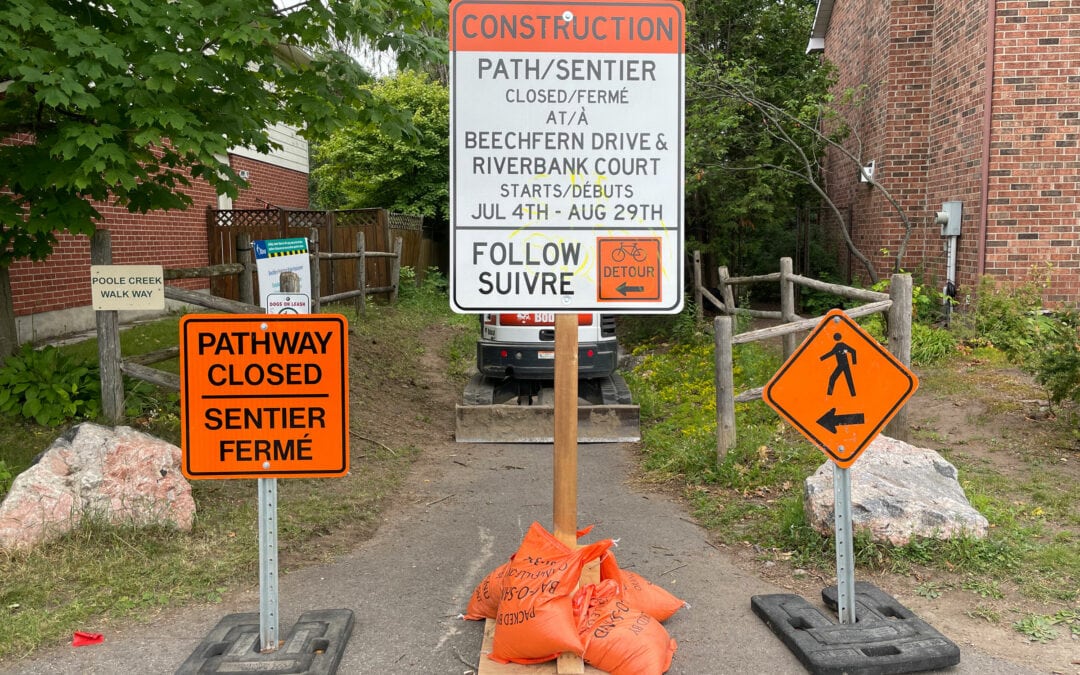
(Photo from the 2022 Poole Creek Pathway bridge replacement between Beechfern and Riverbank in Wyldewood.)
The City’s Finance Committee sunk its teeth into a meaty policy document on Tuesday titled “Long Range Financial Plan VI – Tax Supported Capital”.
The staff report and recommendations are meant to help us plan for the cost of building, maintaining, and replacing infrastructure: roads, bridges, community centres, swimming pools, parks, administrative buildings, and so on.
There are three parts of this report that I want to highlight:
- The backlog and cost of repairs
- A new pilot to speed up new road construction in areas like Stittsville
- What the city does with older buildings when they reach end-of-life
The infrastructure backlog
We have a long list of repairs and costs are going up: construction is getting more expensive, new requirements (for example, climate change resilience and accessibility features) are more expensive. Council tends to deferred non-urgent repairs to save money, but you can only do that for so long.
Over the next decade we’re facing a funding gap of about $229-million per year between what’s currently budgeted and what’s needed to catch up. Staff are recommending the use of reserve funds and borrowing money to finance the immediate upkeep.
This will put pressure on the City budget of up to $30-million per year, and Council will have to decide in the next term how to manage that. There’s talk of an infrastructure levy (an extra fee on the property tax bill), but that’s not a given. Council could also choose to reduce spending in other areas or juggle priorities to absorb the extra cost without a levy or at tax increase.
Most cities in Canada and the United States are facing similar infrastructure gaps. (In Canada, the municipal infrastructure deficit is estimated to be at least $150-billion, and every city struggles with funding upkeep.) We need this infrastructure for a functioning, healthy City, but we lack the revenue tools to pay for the maintenance. While municipalities own and maintain about 60% of public infrastructure in the country, we only receive about 8 cents of every tax dollar in revenue.
Groups like the Federation of Canadian Municipalities and the Association of Municipalities of Ontario have been lobbying the provincial and federal governments to introduce fair, predictable funding for infrastructure upkeep.
It’s a pressing issue that we’re going to hear more about in the coming years.
A pilot to speed up new road construction
This is a proposed budgeting and accounting change that should prevent delays where one road project holds up others in the queue.
Often road projects can get caught up in design work or property acquisition that temporarily stops the work. The millions of dollars allocated for that project remain unspent, and the money can’t be reallocated to the next project on the list, even if it’s ready to go.
The new pilot would let the next projects proceed, even if the first project gets held up. To me it’s like when someone is in line at a grocery store with a very full cart, and they let the person behind them with only one item go first. It keeps the line moving, no chokepoints.
If the pilot works, this could speed up a number of near-term transportation projects in Stittsville, including:
- Carp Road expansion
- Stittsville Main Street extension (Maple Grove to Derreen)
- Robert Grant Avenue extension (Hazeldean to Palladium)
- Terry Fox Drive – additional turning lanes (Winchester to Abbott)
- Upgrades to Fernbank Road, Shea Road, and Maple Grove Road including sidewalks
Older buildings at the end of their lifespan
As infrastructure and buildings age out, there should be funding available to replace them – but that hasn’t always been the case. The report recommends creating a new fund for facility replacement, by taking on some more debt and using money from the disposal of old facilities to build new ones.
“Disposal” means that some older buildings and land could eventually be sold, but the intent is to provide similar services in new buildings elsewhere in the community.
In Stittsville, a good example of this is the Pretty Street Community Centre. A few years back, an inspection found that it was infested with mold and deemed too costly to repair. The property is being transferred to a non-profit housing developer, and any proceeds from the sale will be reallocated towards a new project: building a permanent home for the Stittsville Food Bank on Stittsville Main Street.
The public works depot on Maple Grove Road is another facility that is nearing the end of its useful life, and could be sold while its equipment and personnel get consolidated within another public works building nearby – either new or existing.
Closing down a facility is never an easy decision or a first choice. A future councillor will have to work with staff and residents to make responsible decisions that balance finances with emerging community needs.
More information
I’ve picked three elements of the report to highlight here, but there’s a lot more. If you’re interested in tax policy and infrastructure requirements, you can find more information here below, or contact me with your questions or comments. Council will vote on the recommendations on June 10.
- Report: Long Range Financial Plan VI – Tax Supported Capital (PDF)
- Staff presentation: Tax LRFP Update (PDF)
- YouTube: Finance & Corporate Services Committee Item 4.3
CARNET DE NOTES : Pressions sur les infrastructures, nouveaux projets routiers et choix difficiles à venir
(Photo du remplacement du pont du sentier du ruisseau Poole en 2022, entre la promenade Beechfern et la cour Riverbank, à Wyldewood.)
Mardi, le Comité des finances de la Ville s’est attaqué à un imposant document d’orientation intitulé « Plan financier à long terme VI – Immobilisations financées par les taxes ».
Le rapport du personnel et les recommandations visent à nous aider à planifier le coût de la construction, de l’entretien et du remplacement des infrastructures : routes, ponts, centres communautaires, piscines, parcs, bâtiments administratifs, etc.
Le présent rapport comporte trois volets que je veux mettre en lumière :
- l’arriéré et le coût des réparations;
- un nouveau projet pilote visant à accélérer la construction de nouvelles routes dans des secteurs comme Stittsville;
- ce que la Ville fait des bâtiments plus anciens lorsqu’ils arrivent à la fin de leur cycle de vie.
L’arriéré des infrastructures
Nous avons une longue liste de réparations à effectuer, et les coûts augmentent : les travaux de construction coûtent de plus en plus cher, et les nouvelles exigences (par exemple, la résilience aux changements climatiques et les caractéristiques d’accessibilité) coûtent elles aussi davantage. Le Conseil municipal a tendance à reporter les réparations non urgentes pour économiser de l’argent; mais on ne peut pas le faire indéfiniment.
Au cours de la prochaine décennie, nous devrons composer avec un manque de financement d’environ 229 millions de dollars par année entre les sommes actuellement prévues au budget et celles nécessaires pour rattraper le retard. Le personnel recommande d’utiliser les fonds de réserve et d’emprunter de l’argent pour financer l’entretien immédiat.
Cela exercera une pression pouvant atteindre 30 millions de dollars par année sur le budget de la Ville, et le Conseil municipal devra décider, au cours du prochain mandat, comment gérer cette situation. Il est question d’un prélèvement pour les infrastructures (des frais supplémentaires sur le compte de taxes foncières), mais rien n’est encore décidé. Le Conseil municipal pourrait aussi choisir de réduire les dépenses dans d’autres secteurs ou de réorganiser les priorités afin d’absorber le coût supplémentaire sans prélèvement ni hausse de taxes.
La plupart des villes au Canada et aux États-Unis font face à des lacunes semblables en matière d’infrastructures. (Au Canada, le déficit des infrastructures municipales est estimé à au moins 150 milliards de dollars, et chaque ville peine à financer l’entretien.) Nous avons besoin de ces infrastructures pour assurer le bon fonctionnement et la salubrité de la ville, mais nous ne disposons pas des outils de financement nécessaires pour en assumer les coûts d’entretien. Bien que les municipalités possèdent et entretiennent environ 60 % des infrastructures publiques du pays, elles ne reçoivent qu’environ huit cents sur chaque dollar perçu en recettes fiscales.
Des groupes comme la Fédération canadienne des municipalités et l’Association des municipalités de l’Ontario font pression sur les gouvernements provincial et fédéral pour qu’ils mettent en place un financement équitable et prévisible pour l’entretien des infrastructures.
C’est une question urgente dont nous entendrons davantage parler au cours des prochaines années.
Un projet pilote pour accélérer la construction de nouvelles routes
Il s’agit d’un changement proposé en matière de budgétisation et de comptabilité qui devrait éviter qu’un projet routier retarde les autres projets dans la file d’attente.
Souvent, des projets routiers se retrouvent bloqués à l’étape de la conception ou de l’acquisition de terrains, ce qui interrompt temporairement les travaux. Les millions de dollars affectés à ce projet demeurent inutilisés, et l’argent ne peut pas être réaffecté au projet suivant sur la liste, même si celui-ci est prêt à aller de l’avant.
Le nouveau projet pilote permettrait de faire avancer les projets suivants, même si le premier projet est retardé. Pour moi, c’est comme à l’épicerie, lorsqu’une personne ayant un panier bien rempli laisse passer devant elle une autre personne qui n’a qu’un seul article. Cela permet à la file d’avancer, sans goulot d’étranglement.
Si le projet pilote fonctionne, il pourrait accélérer un certain nombre de projets de transport à court terme à Stittsville, notamment :
- Agrandissement du chemin Carp
- Prolongement de la rue Main de Stittsville (du chemin Maple Grove à l’avenue Derreen)
- Extension de l’avenue Robert-Grant (du chemin Hazeldean à la promenade Palladium)
- Promenade Terry Fox (voies de virage additionnelles, entre la promenade Winchester et la rue Abbott)
- Améliorations du chemin Fernbank, du chemin Shea et du chemin Maple Grove, y compris des trottoirs
Bâtiments plus anciens arrivés à la fin de leur durée de vie utile
À mesure que les infrastructures et les bâtiments vieillissent, des fonds devraient être disponibles pour les remplacer; mais cela n’a pas toujours été le cas. Le rapport recommande de créer un nouveau fonds pour le remplacement des installations, en contractant davantage de dettes et en utilisant l’argent provenant de la cession d’anciennes installations pour en construire de nouvelles.
Par « cession », on entend que certains bâtiments plus anciens et certains terrains pourraient éventuellement être vendus, mais l’objectif est d’offrir des services comparables dans de nouveaux bâtiments ailleurs dans la collectivité.
À Stittsville, le Centre communautaire de la rue Pretty en est un bon exemple. Il y a quelques années, une inspection a révélé la présence de moisissure dans le bâtiment et a conclu que les réparations seraient trop coûteuses. La propriété est en cours de transfert à un promoteur de logements sans but lucratif, et tout produit de la vente sera réaffecté à un nouveau projet : la construction d’un emplacement permanent pour la Banque alimentaire de Stittsville sur la rue Main de Stittsville.
Le dépôt des travaux publics du chemin Maple Grove est une autre installation qui approche de la fin de sa durée de vie utile et qui pourrait être vendue, tandis que son équipement et son personnel seraient regroupés dans un autre bâtiment des travaux publics situé à proximité, qu’il soit nouveau ou existant.
La fermeture d’une installation n’est jamais une décision facile ni un premier choix. Un futur conseiller municipal devra travailler avec le personnel et les résidents pour prendre des décisions responsables qui concilient les finances et l’évolution des besoins de la collectivité.
Plus d’informations
J’ai choisi de mettre en évidence trois éléments du rapport ici, mais il y en a beaucoup d’autres. Si les politiques fiscales et les besoins en infrastructures vous intéressent, vous trouverez plus de renseignements ci-dessous, ou vous pouvez communiquer avec moi pour me faire part de vos questions ou commentaires. Le Conseil municipal votera sur les recommandations le 10 juin.
- Rapport : Long Range Financial Plan VI – Tax Supported Capital (PDF)
- Présentation du personnel : Tax LRFP Update (PDF)
- YouTube : Comité des finances et des services organisationnels, point 4.3