
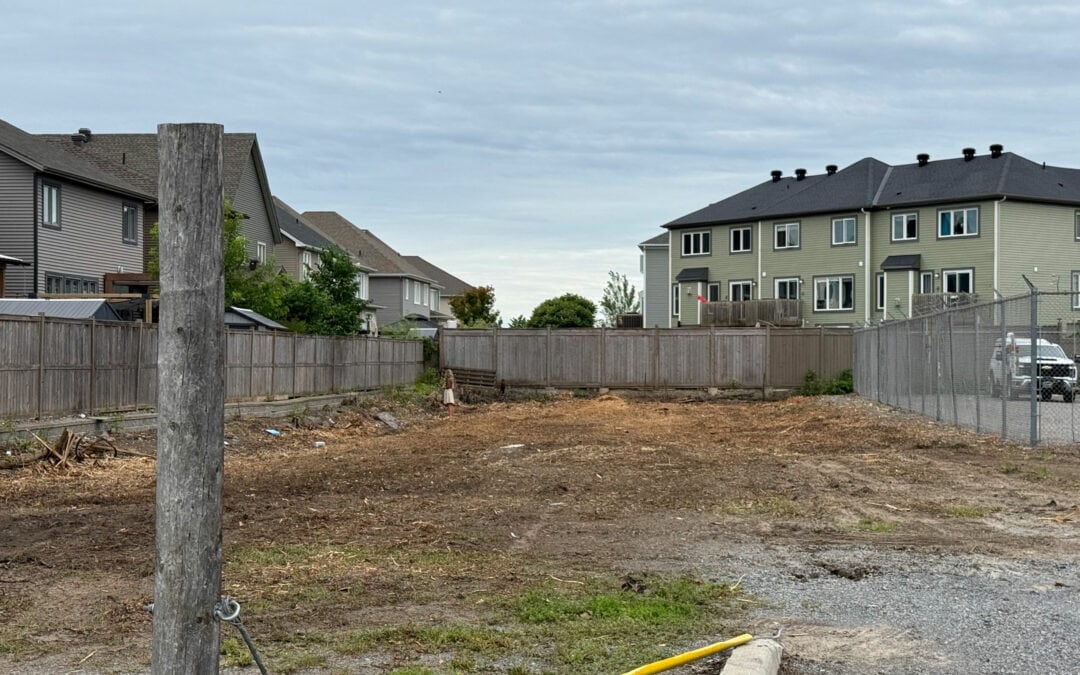
Photo: Empty land after the trees and vegetation were removed
La version française suit
In mid-June, a contractor removed most of the vegetation at Hydro One’s Alexander Distribution Centre at 1888 Maple Grove Road. The trees and vegetation that were removed provided a visual and sound buffer between homes and the hydro station, along with shade and tree canopy for the community.
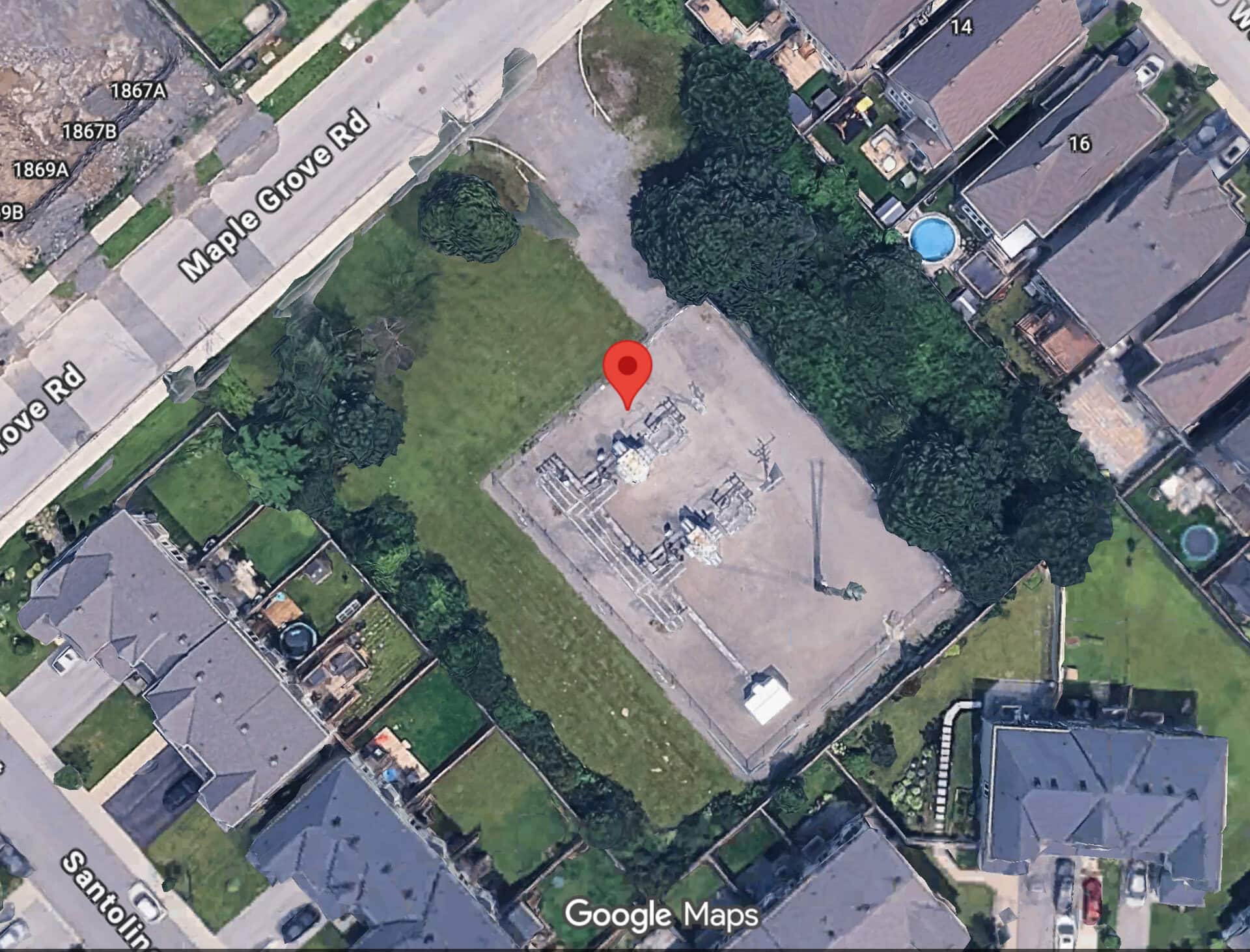
Screenshot of the site from Google Maps, captured earlier in 2026 before the vegetation was removed.
We met on-site with neighbours on August 5 to provide an update on our conversations with Hydro One, and potential options going forward.
At the meeting, we shared a general background including a summary of meetings and correspondence we’ve received from Hydro One, including:
1. My office has had two virtual meetings with representatives from Hydro One’s Community Relations department, once on June 25 and another on July 10. In both of those meetings, we requested additional context about why the vegetation clearing occurred; we asked for more clarity around their processes for maintenance and communication with residents; we asked Hydro One to meet directly with affected residents to address questions and concerns; and we have advocated for appropriate mitigation measures to address the tree loss, including the planting of new trees in the buffer zone.
2. We also consulted with the City of Ottawa’s forestry department to check if the vegetation and tree clearing violated any city regulations or by-laws.
Hydro One has broad authority under Ontario’s Electricity Act (1998) to manage vegetation around critical infrastructure, including a statutory right to maintain infrastructure and remove obstructions at their discretion. There is no appeal or review process.
The City of Ottawa’s Tree Protection By-Law exempts tree removal that is required for maintenance of a transmission or distribution system.
3. Hydro One provided the following rationale to my office by e-mail:
Technical rationale and safety standardsThe specific scope of vegetation management work at Alexander DS was governed by critical operational and safety considerations:
4. Hydro One has not been willing to participate in a community meeting – virtual or on-site – with residents: “To ensure all resident feedback is properly logged, tracked and addressed individually, we ask that residents continue to be directed to our Customer Relations team at CustomerRelations@HydroOne.com.”
5. Hydro One says they will not plant new trees on the site: “While we have heard from some in the neighborhood who have expressed concerns regarding the work and loss of visual screening, Hydro One will not be planting new trees or vegetation on the station property. Doing so would reintroduce the same safety, operational and pest-control risks that this maintenance was required to eliminate.”
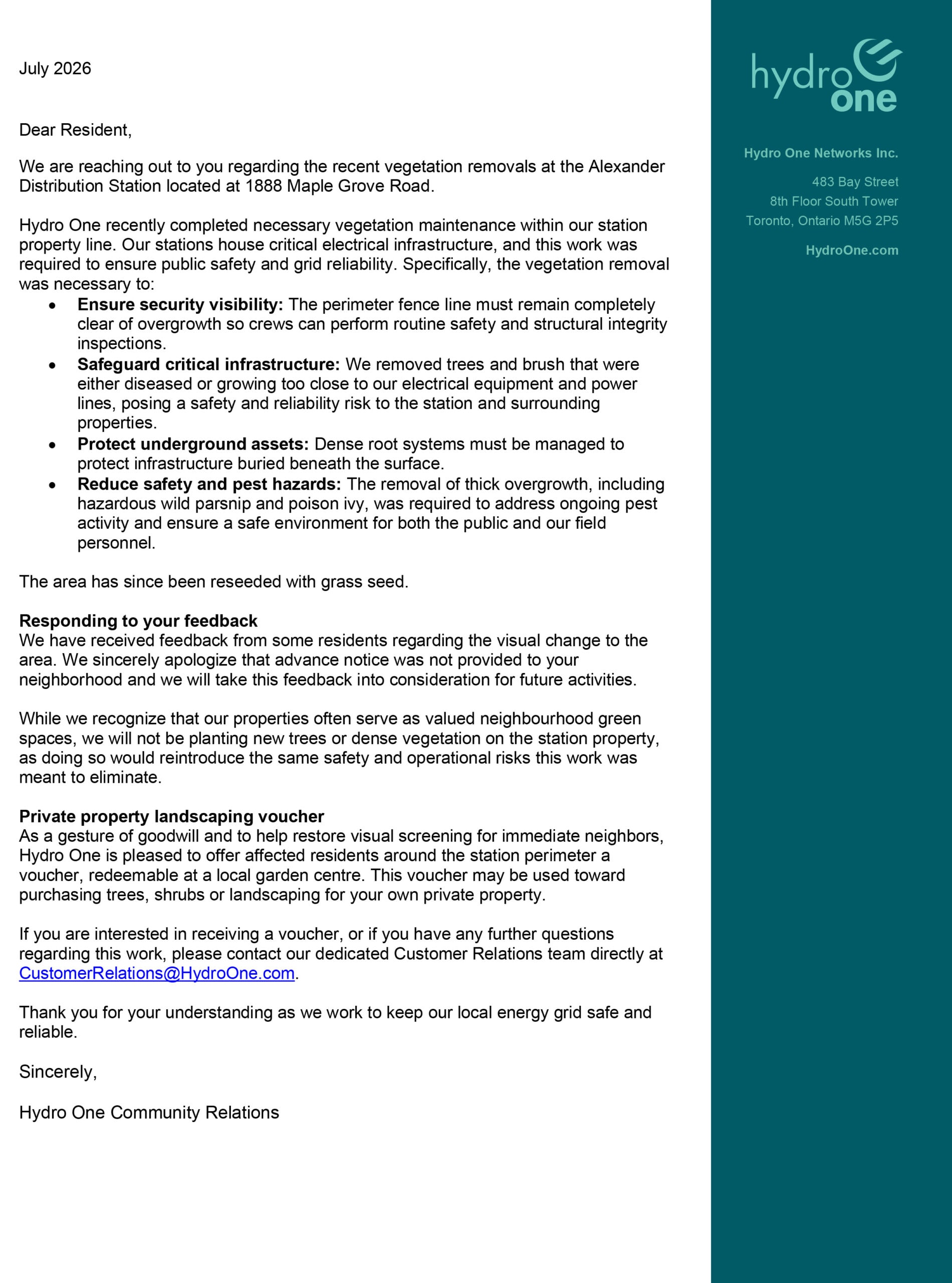
6. In the past week, Hydro One sent this letter to property owners who back onto the facility, which includes an offer for a landscaping voucher for trees, shrubs, or landscaping on private property.
7. Some residents have lodged a formal complaint with the Hydro One ombudsman, who has concluded that “Hydro One did not act unreasonably when it chose to remove the vegetation on the station property and offer compensation in the form of nursery vouchers”.
What’s next?
We made two recommendations to residents:
- Our office will continue to pursue new tree planting on site as mitigation for the vegetation loss, on behalf of residents.
- Residents should documenting any property damage to retaining walls, fencing, etc. on individual property due to the maintenance work, and seeking legal advice.
There were also several questions at the meeting that we will follow up on, including:
- Who owns the retaining walls and who is responsible for maintenance?
- Are there any agreements within the subdivision plan, or easement rights, etc. that could apply to the buffer zone around the hydro site.
- What are the requirements for buffer zones and/or mitigation around new electrical stations?
- Can Hydro One be required to build a taller fence as a mitigation measure?
Déboisement par Hydro One : Nouvelles et prochaines étapes
À la mi-juin, un entrepreneur a retiré la majeure partie de la végétation au centre de distribution Alexander de Hydro One, situé au 1888, chemin Maple Grove. Les arbres et la végétation formaient auparavant une barrière visuelle et acoustique entre les maisons et la centrale électrique, tout en offrant de l’ombre et une canopée.
Nous avons rencontré les résidentes et les résidents le 5 août afin de faire le point sur l’avancement de nos discussions avec Hydro One et les options pour l’avenir.
Lors de la réunion, nous avons présenté le contexte général, notamment un résumé des rencontres avec Hydro One et de la correspondance reçue, y compris ce qui suit :
- Nous avons tenu deux réunions virtuelles avec des représentants de la direction des relations avec la clientèle de Hydro One, soit le 25 juin et le 10 juillet. Au cours de ces deux réunions, nous avons demandé des explications complémentaires sur les motifs du déboisement, nous avons réclamé une plus grande transparence concernant les processus d’entretien et de communication avec les résidentes et les résidents, nous avons demandé à Hydro One de rencontrer directement les personnes touchées afin de répondre à leurs questions et à leurs préoccupations, et nous avons également insisté pour que des mesures d’atténuation appropriées soient mises en place afin de compenser la perte d’arbres, notamment par la plantation de nouveaux arbres dans la zone tampon.
- Nous avons également consulté les Services forestiers de la Ville d’Ottawa pour vérifier si le déboisement enfreignait des règlements municipaux.
Hydro One dispose de pouvoirs importants en vertu de la Loi de 1998 sur l’électricité de l’Ontario pour gérer la végétation autour des infrastructures essentielles, y compris le droit légal d’entretenir les infrastructures et de retirer les obstacles à sa discrétion. Il n’existe aucune procédure d’appel ni d’examen.
Le Règlement sur la protection des arbres de la Ville d’Ottawa autorise l’abattage d’arbres requis pour l’entretien d’un réseau de transport ou de distribution.
- Hydro One a fourni la justification suivante à mon bureau par courriel :
Analyse technique et normes de sécurité
Les travaux de gestion de la végétation au centre de distribution Alexander étaient régis par des considérations opérationnelles et de sécurité essentielles :
- Office de la sécurité des installations électriques (OSIE) et codes de sécurité : Hydro One est légalement tenue de se conformer aux normes de sécurité provinciales pour prévenir les risques d’escalade par le public, les risques d’incendie et les éclats d’arc électrique. La végétation envahissante enfreint directement ces normes.
- Exigences relatives aux systèmes souterrains et à la sécurité : le dégagement prescrit est essentiel non seulement pour les lignes aériennes, mais également afin de protéger les fils et les tapis de mise à la terre souterrains enfouis sous terre. De plus, la ligne de clôture périphérique doit demeurer entièrement dégagée de toute végétation afin de garantir son entière visibilité lors des inspections courantes de sécurité et de l’intégrité structurale.
- Risques propres au site : le déboisement a également été suscité par des plaintes directes de la communauté et de l’ombudsman concernant la densité de la végétation, qui favorisait une forte présence de rongeurs et de rats nuisant aux propriétés voisines. En raison d’une présence abondante de panais sauvage et d’herbe à puce, le déboisement du site ne pouvait pas être effectué à la main en toute sécurité, nécessitant l’utilisation d’équipement mécanique de défrichage afin d’éliminer de façon sécuritaire les habitats de rongeurs et les risques pour la sécurité du public et des membres du personnel sur le terrain.
- Hydro One n’a pas souhaité participer à une réunion communautaire virtuelle ni en personne avec les résidentes et les résidents : « Afin que tous les commentaires des résidentes et des résidents soient consignés, suivis et traités individuellement de façon adéquate, nous demandons à ce que les résidentes et les résidents continuent d’être dirigés vers notre équipe des relations avec la clientèle à CustomerRelations@HydroOne.com. »
- Hydro One affirme qu’elle ne plantera pas de nouveaux arbres sur le site : « Bien que nous ayons écouté les préoccupations de certaines résidentes et de certains résidents du quartier concernant les travaux et la perte de la barrière visuelle, Hydro One ne plantera pas de nouveaux arbres ni de végétation sur la propriété de la centrale. Cela réintroduirait les mêmes risques opérationnels et liés à la sécurité et à la lutte antiparasitaire que ces travaux d’entretien visaient à éliminer. »
- La semaine dernière, Hydro One a envoyé une lettre aux propriétaires fonciers dont le terrain jouxte l’installation, laquelle comprenait un bon d’aménagement paysager pour la plantation d’arbres et d’arbustes ou l’aménagement paysager sur une propriété privée.
- Certaines résidentes et certains résidents ont déposé une plainte officielle auprès de l’ombudsman de Hydro One, qui a conclu que « Hydro One n’a pas agi de manière déraisonnable lorsqu’elle a choisi de déboiser la propriété de la centrale et d’offrir une compensation sous la forme de bons de pépinière ».
Quelles sont les prochaines étapes?
Nous avons formulé deux recommandations aux résidentes et aux résidents :
- Notre bureau poursuivra ses efforts pour la plantation de nouveaux arbres sur le site afin d’atténuer la perte de végétation, au nom des résidentes et des résidents.
- Les résidentes et les résidents devraient consigner tout dommage matériel causé aux murs de soutènement, aux clôtures, etc., sur leur propriété par les travaux d’entretien, et obtenir des conseils juridiques.
Nous donnerons également suite à plusieurs questions qui ont été soulevées lors de la réunion, notamment :
- À qui appartiennent les murs de soutènement et qui est responsable de leur entretien?
- Existe-t-il des ententes dans le plan de lotissement, des droits de servitude, etc., qui pourraient s’appliquer à la zone tampon autour du site?
- Quelles sont les exigences relatives aux zones tampons et/ou aux mesures d’atténuation autour des nouvelles centrales électriques?
- Peut-on exiger de Hydro One qu’elle construise une clôture plus haute en guise de mesure d’atténuation?