
La version française suit
This post was originally published in my Substack newsletter
OC Transpo has been publishing weekly updates every Friday with information about the number of buses and trains in service. Over five weeks, we’re seeing slow but steady progress to stabilize the bus fleet.
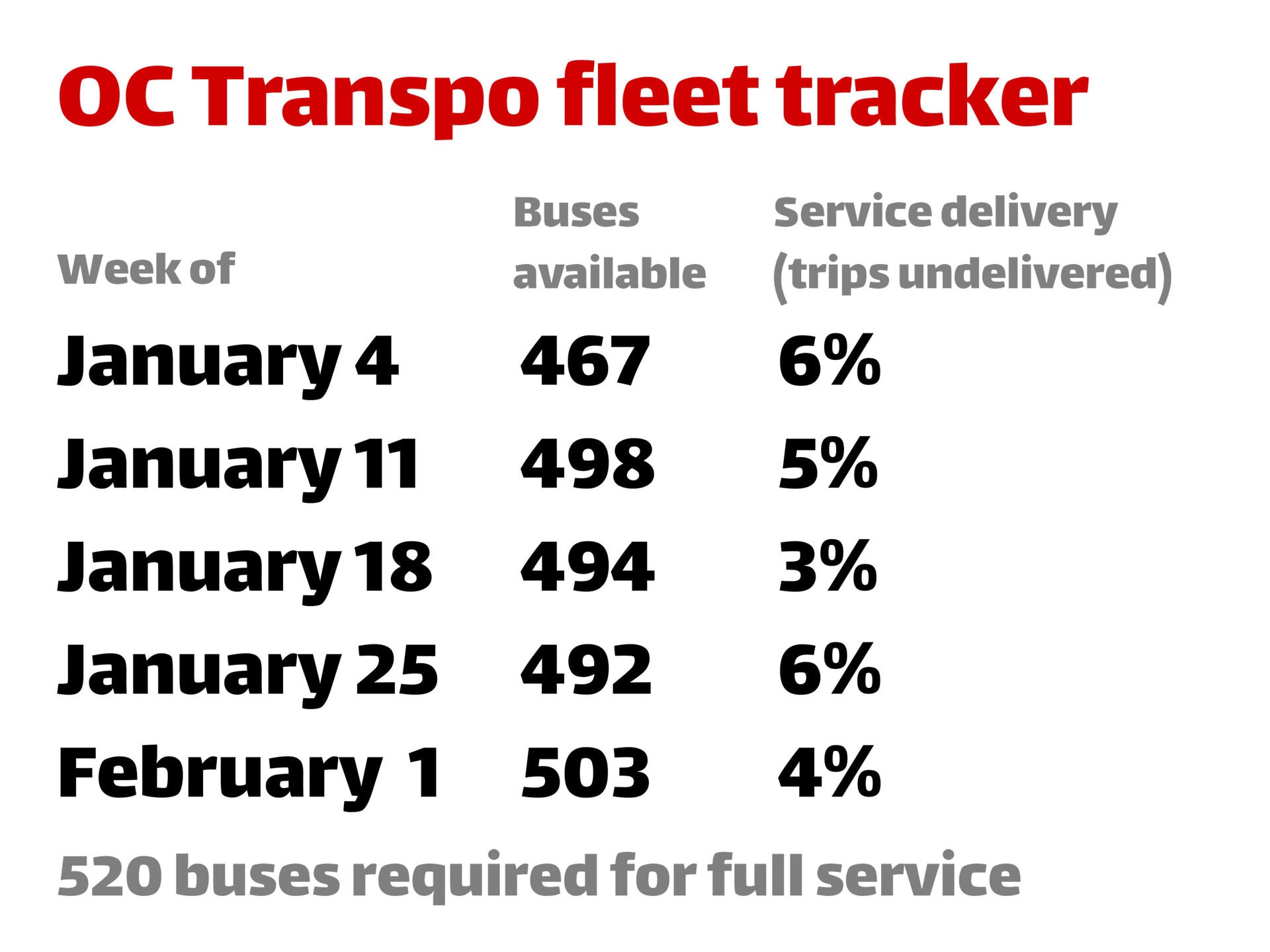
The small improvements are largely thanks to new electric buses arriving (49 now in service), and a reduction in the maintenance backlog. We went into a high degree of detail on what’s happening with the bus fleet at Transit Committee yesterday, and I’ve shared a link to the presentation slides and full YouTube video on my web site.
***
On the rail side, we’ve been steady at 20 or 21 trains available for service each weekday. Seems like every time a vehicle returns to service, another one is taken out for routine maintenance and inspections. Single-car trains are still running every 3-4 minutes during the peak periods and for the most part that’s enough capacity. But it leaves no margin for error in the event of an unexpected issue, of which we’ve had several.
OC Transpo Interim General Manager Troy Charter was on CBC Ottawa Morning again today and his 10-minute interview gives a pretty good recap of what we covered at committee. A few key points:
On what’s preventing the start of trial running for the Line 1 East extension to Trim Road: “Right now we’re down to a few key issues. The main one is what we call ‘platform edge cameras’. These are the CCTV cameras that give a view to the operator that the train is safe to depart the station. So obviously that’s a critical safety feature that we need to make sure that it’s rectified before we go into service. So that’s the main primary issue right now that the teams are working through is resolving some of the camera angles and deficiencies associated with these CCTV cameras.”
On whether the lack of vehicles due to the spalling issue will hold up trial running and launch of the train: “It’s not affecting things on the extension at this time. I would prefer to be running trains and practicing and doing all that work in advance, but we know that we’ve done practice exercises. We had our operators out on the line – we ran 23 trains last year – so we know that we can run the 23 trains, we’ve done it reliably. Right now though the reduction in the number trains is not impacting our ability to move towards substantial completion. But I’ve been clear in saying that to proceed to trial running we will need more trains available. So that could cause an impact that if we don’t resolve the issue between now and substantial completion achieved. So I’ve got our rail construction team – they’re focused on the rail construction, achieving substantial completion. And then I’ve got our engineering team and our OC team here working with RTG and Alstom who are responsible for the vehicles and the spalling issue to come up with a solution, both short-, medium-, and long-term, so that we can get into service.”
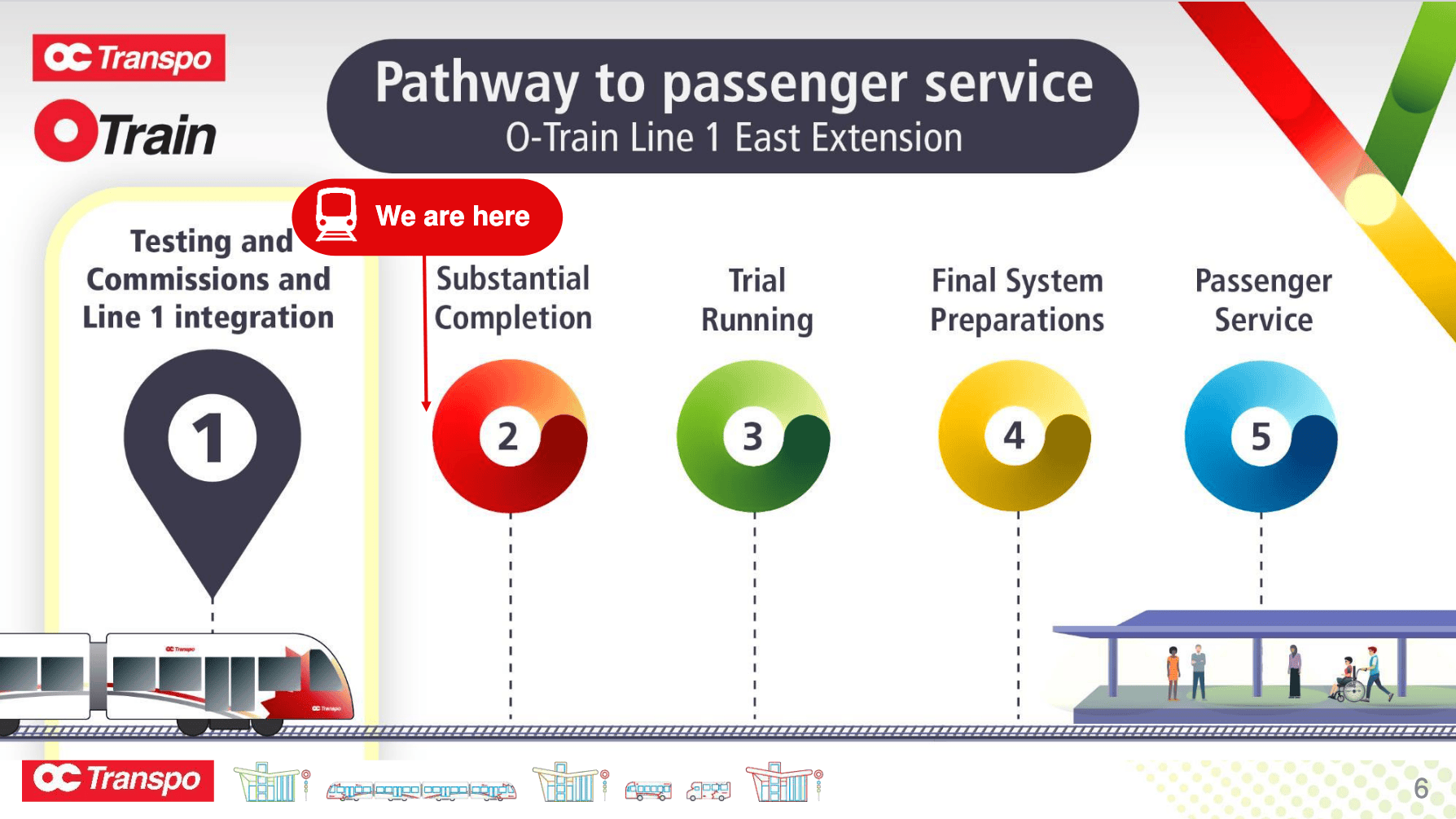
Once the City of Ottawa and OC Transpo confirm “substantial completion”, they proceed to 21-day trial running – one of the final steps of testing before passenger service. It’s a similar process used for the launch of Line 2/4 last year.
On how long it might be before there are significantly more trains back: “[RTG is] replacing any of these cartridge bearing assemblies or axles that have over 100,000 kilometers. That’s where you’re seeing the slow growth from 18/19/20/21 [trains]. But in parallel to do that we’re working with their engineers and their bearing experts to validate processes, tools and procedures that can identify if spalling exists on the cartridge bearing assemblies, so that we can confirm that the fleet is safe to continue operation… That would allow us to reassess the 100,000km restriction to maybe go to 200,000km or even possibly completely remove… To be fair to RTG, they have said that the fleet is safe for continued operation. And the City said ‘well OK that’s great but out of an abundance caution we want to see the information, we want to validate all the processes, we want to validate the tools you’re using, we want to see that information and then we can reassess that 100,000km restriction.’ …And in the long term obviously is we need to continue with all the root cause analysis and investigation so that we have a permanent solution moving forward.”
On how the redesign of the cartridge bearing assemblies – the “sustainable solution” is coming along: “RTG has started to supply us with the necessary technical information design drawings for a redesigned cartridge bearing assembly so they’ve advanced that process and we’re starting … they’re doing their evaluation on ‘are we ready to go to a prototype phase’ and they’re including us in those discussions… work on the redesign is progressing.”
CARNET DE NOTES : Qu’est-ce qui retarde le prolongement de la Ligne 1 vers l’est?
Publication initialement parue dans le bulletin d’information Substack
Chaque vendredi, OC Transpo fait le point sur le nombre d’autobus et de trains en service. Depuis cinq semaines, nous constatons, tranquillement mais sûrement, des progrès vers la stabilisation du parc d’autobus.
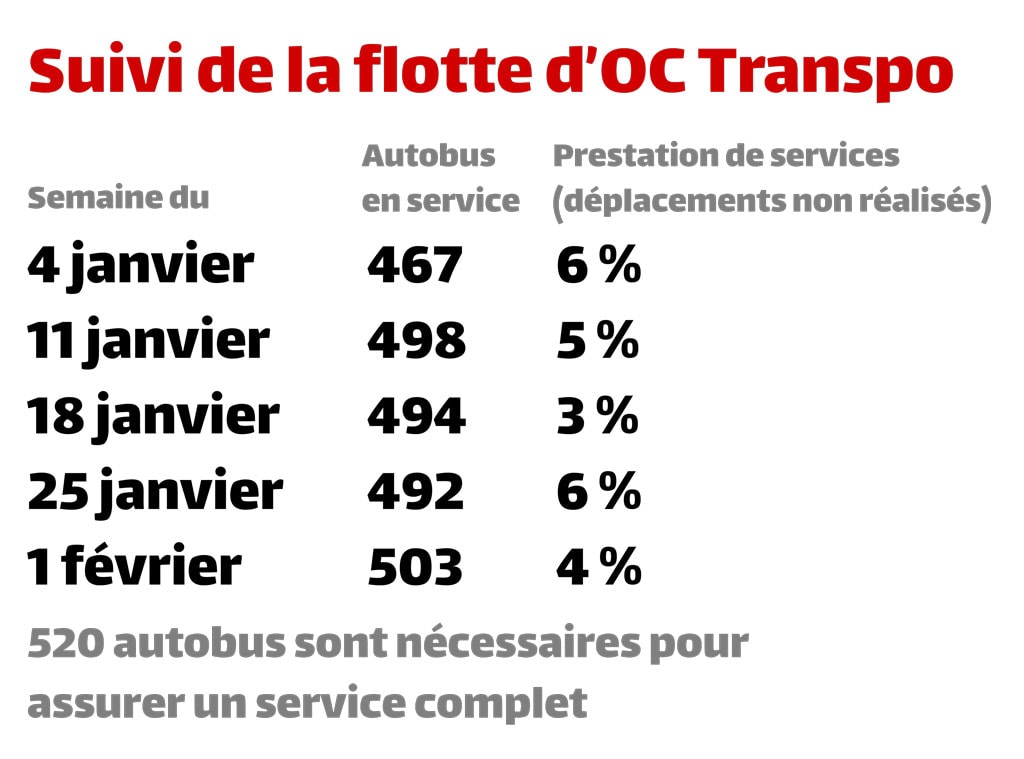
Ces petites améliorations sont possibles en grande partie grâce à l’arrivée de nouveaux autobus électriques (49 actuellement en service) et au rattrapage du retard dans l’entretien. Hier, lors d’une réunion du Comité du transport en commun, nous avons discuté en long et en large de la situation actuelle du parc d’autobus. J’ai partagé un lien vers le diaporama et la vidéo complète sur YouTube sur mon site Web.
***
En ce qui concerne les trains, la stabilité est au rendez-vous : entre 20 et 21 trains sont en service chaque jour de la semaine. On dirait qu’à chaque fois qu’un véhicule est de retour en service, un autre doit être retiré pour des raisons d’inspection et d’entretien de routine. En période de pointe, les trains à une voiture passent toutes les trois ou quatre minutes. De manière générale, cette fréquence répond à la demande. Toutefois, la capacité est dépassée aussitôt qu’il y a un imprévu, ce qui s’est produit souvent dernièrement.
Troy Charter, directeur général par intérim d’OC Transpo, était à l’émission Ottawa Morning de la CBC encore aujourd’hui. Son entrevue de 10 minutes résume assez bien les points couverts à la réunion du Comité. Voici quelques éléments clés :
Qu’est-ce qui empêche la période de rodage du prolongement de la Ligne 1 vers l’est jusqu’au chemin Trim? « Il ne reste que quelques détails clés à régler. Le principal problème est ce qu’on appelle les “caméras en bordure de quai”. Il s’agit des caméras de TVCF qui permettent à l’opérateur de savoir quand le train peut partir en toute sécurité. Évidemment, il faut garantir le bon fonctionnement de ces dispositifs avant la mise en service. Le principal problème que les équipes tentent de régler touche certains angles de caméra et des défaillances des dispositifs. »
Est-ce que le manque de véhicules en raison du problème d’effritement retardera la période de rodage et l’ouverture de la ligne ? « Pour le moment, ce problème ne nuit pas au prolongement de la ligne. Je préférais mettre à l’essai les trains et faire tout ce travail à l’avance, mais nous savons que nous avons déjà fait des essais. Nous avons déjà eu des opérateurs sur la ligne : nous avons opéré 23 trains l’année dernière de manière fiable. Alors nous savons que c’est possible de le faire. Pour l’instant, la quantité moindre de trains ne nuit pas à l’achèvement substantiel des travaux. Toutefois, j’ai déjà clairement dit que pour la période de rodage, il nous faudra plus de trains. Alors ce problème pourrait nous nuire si on ne le résout pas avant l’achèvement substantiel des travaux. C’est sur ça que se concentre notre équipe de Construction du TLR. Aussi, notre équipe d’ingénierie et notre équipe d’OC Transpo travaillent avec le GTR et Alstom, qui sont responsables des véhicules et de trouver une solution au problème d’effritement, à court, à moyen et à long terme, pour que nous puissions mettre les trains en service. »
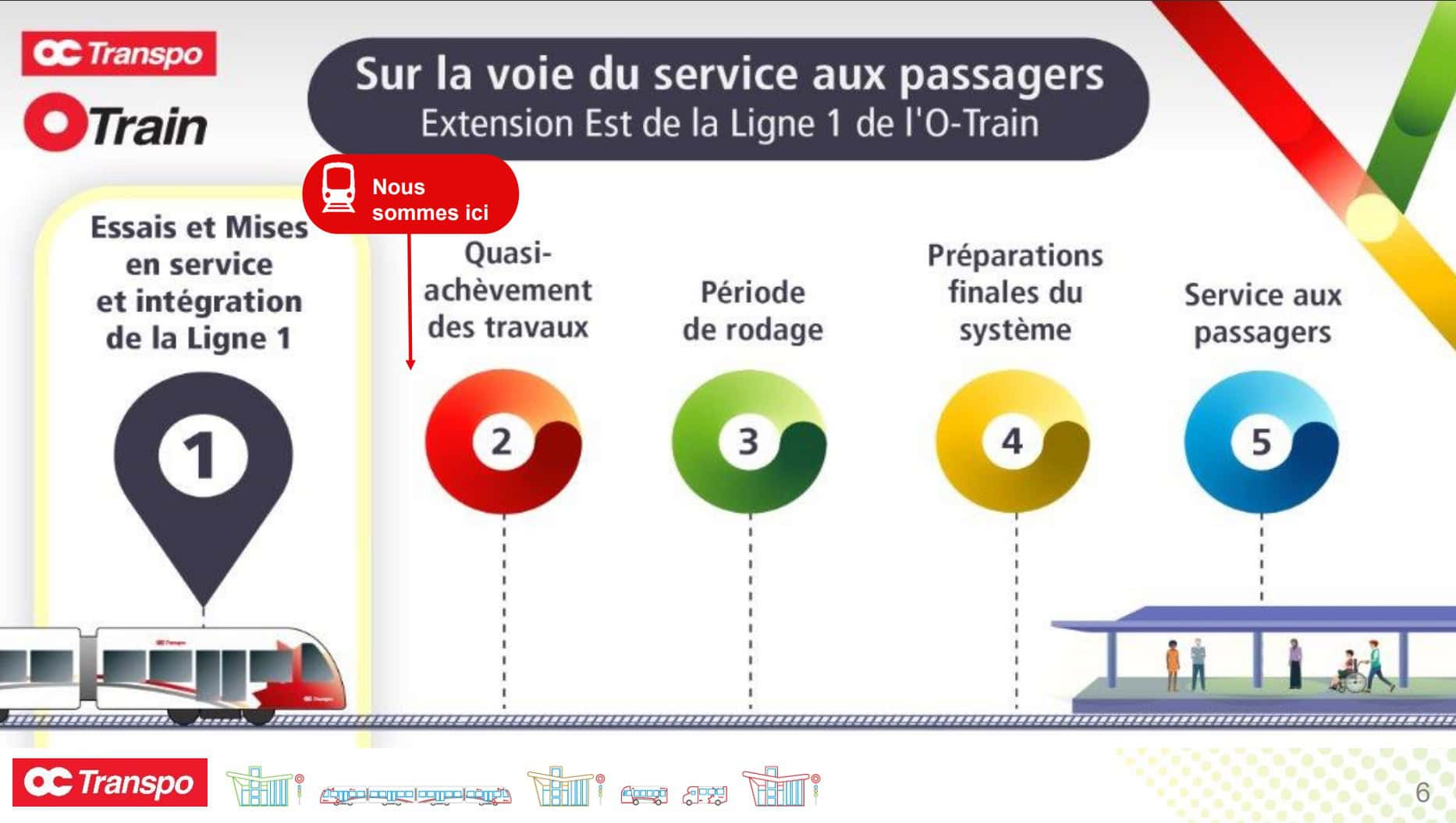
Une fois que la Ville d’Ottawa et OC Transpo confirmeront « l’achèvement substantiel des travaux », il y aura une période de rodage de 21 jours. Il s’agit d’une des dernières étapes d’essai avant la mise en service. Le processus est similaire à celui utilisé l’année dernière pour l’ouverture des Lignes 2 et 4.
Quand y aura-t-il plus de trains? « [Le GTR] remplace les ensembles de roulements cartouches et les essieux des trains qui ont parcouru plus de 100 000 km. C’est ce qui explique la croissance lente de 18/19/20/21 [trains]. En parallèle, nous travaillons avec leurs ingénieures et ingénieurs et leurs spécialistes des roulements pour valider les processus, les outils et les procédures qui peuvent détecter la présence d’effritement sur les ensembles de roulements cartouches afin de garantir la sécurité de nos véhicules. Cela nous permettrait de réévaluer le remplacement obligatoire à 100 000 km pour le repousser à peut-être 200 000 km, voire l’éliminer complètement. Pour être honnête, le GTR nous a dit que les véhicules pouvaient être utilisés en toute sécurité. C’est la Ville qui a dit “c’est bien, mais par excès de prudence, nous voulons connaître toute l’information et valider tous les processus et outils utilisés avant de pouvoir réévaluer le remplacement obligatoire à 100 000 km.” Et évidemment, à long terme, il faut continuer l’analyse des causes profondes et l’enquête pour trouver une solution permanente. »
Quand sera terminée la reconception des ensembles de roulements cartouches (la « solution durable »)? « Le GTR a commencé à nous fournir les dessins techniques nécessaires pour la reconception des ensembles de roulements cartouches. Ce processus est donc en cours, et nous commençons… ils commencent à évaluer s’ils sont prêts à passer à une phase de prototypage et nous participons à ces discussions. Le travail sur la reconception avance bien. »