

La version française suit
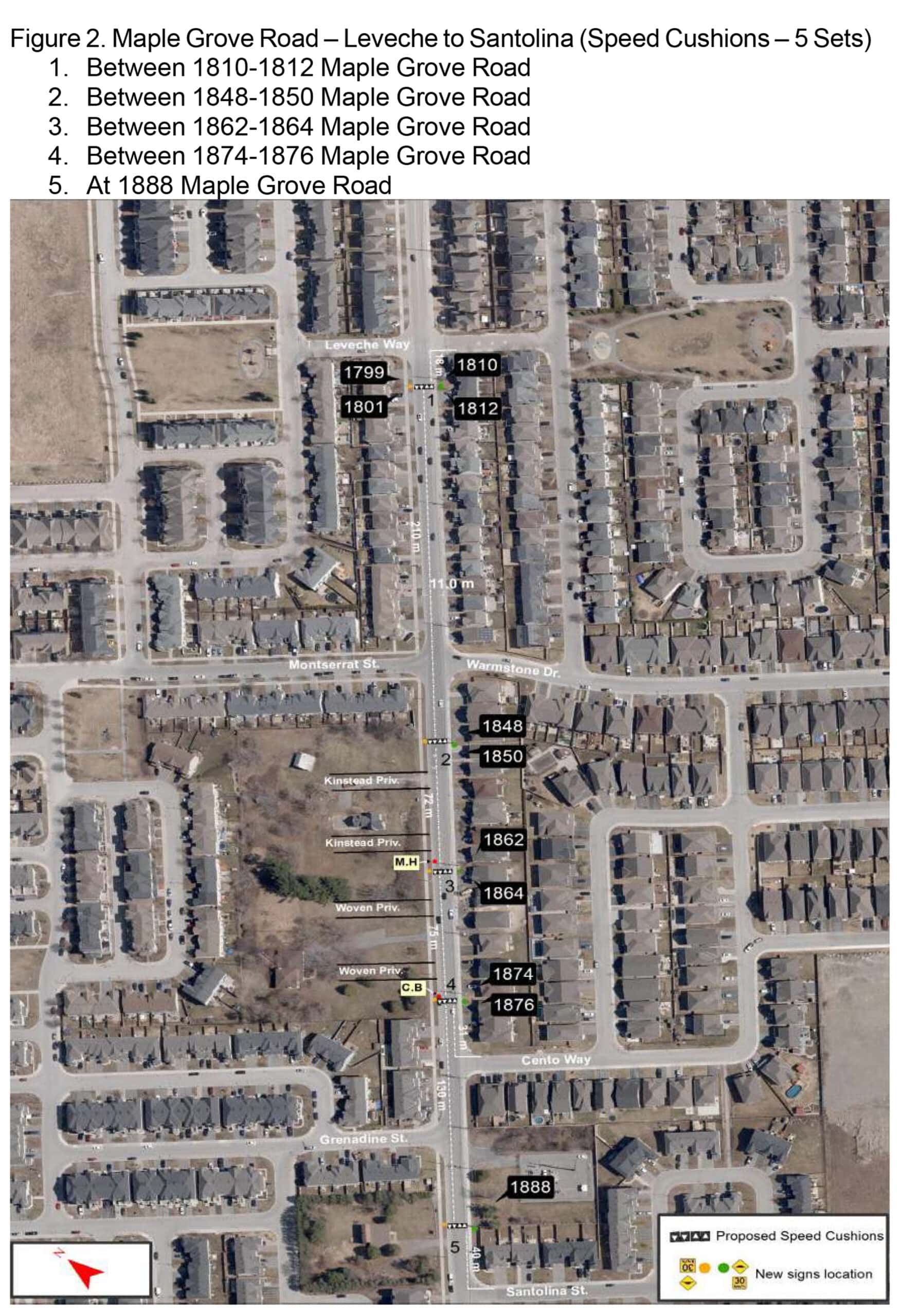
In late September 2026, the City of Ottawa will begin installation of speed cushions along Maple Grove Road between Leveche and Santolina. This installation will reduce vehicle speeds, and increase pedestrian and cyclist safety. The work will be completed by early December 2026.
The City has retained the contractor, Laurent Leblanc Ltd., to complete the work. To accommodate the proposed construction, temporary lane reductions may be required along with on-street parking restrictions. Access to private properties including pedestrian and cycling access, will be maintained throughout the construction period unless otherwise communicated.
As part of this contract, the contractor is assuming full responsibility for the construction work until it is entirely complete as well as any damages to private property resulting from these construction activities. In the event of such occurrences, all claims for damages should be immediately reported both verbally and in writing to the contractor and to the City on-site Representative. This will ensure prompt notification of appropriate authorities to complete the claim investigations.
For construction activity hours of work, the City of Ottawa follows provincial requirements and the City’s Noise By-law (2017-255). Under the by-law, construction is permitted Monday to Saturday, 7am to 10pm and Sundays/holidays from 9am to 10pm. Any required night work will need a Noise by-law exemption and will be communicated in advance to the community.
Contact information
- For any emergency outside normal working hours, please call the City at 3-1-1.
- For general project information, please contact the City’s Project Manager, Chad Martin, at 613-808-8945 or chad.martin@ottawa.ca.
- For construction related questions or concerns, please contact the Contractor Representative, Dan Bergeron (Laurent Leblanc Ltd.), at 613-830-0066 or dan.bergeron@laurentleblanc.com
Location map
Speed humps vs. speed cushions
- Speed humps are a continuous raised section that extends across the full width of the travel lane, typically used on residential streets with less traffic.
- Speed cushions include separate raised sections with gaps (wheel cut-outs) between them, so that larger vehicles (fire trucks, ambulances, buses) can straddle the cushion and pass with less slowing.
Both types are designed so that all vehicle types can cross over safely at lower speeds, and they do not interfere with snow plows or other service vehicles like garbage trucks, buses, etc. All locations are reviewed and approved by emergency services staff prior to installation.
AVIS DE TRAVAUX : Coussins berlinois sur le chemin Maple Grove
À la fin du mois de septembre 2026, la Ville d’Ottawa commencera à installer des coussins berlinois sur le chemin Maple Grove, entre la voie Leveche et la rue Santolina. Ces coussins permettront de réduire la vitesse des véhicules et d’améliorer la sécurité des piétons et des cyclistes. Les travaux seront terminés au début du mois de décembre 2026.
La Ville a confié à la société Laurent Leblanc Ltd. le mandat d’exécuter les travaux. Afin de permettre la réalisation des travaux prévus, il faudra probablement réduire temporairement le nombre de voies de circulation et restreindre le stationnement sur rue. L’accès aux propriétés privées ainsi que l’accès pour les piétons et les cyclistes seront maintenus pendant toute la durée des travaux, à moins d’indications contraires.
Aux termes de ce contrat, l’entrepreneur est tenu entièrement responsable des travaux jusqu’à leur achèvement complet ainsi que de tout dommage aux propriétés privées qui pourrait en découler. Le cas échéant, toute réclamation devra être signalée immédiatement, verbalement et par écrit, à l’entrepreneur et au représentant de la Ville sur le chantier. Ainsi, les autorités compétentes seront avisées promptement et pourront mener les enquêtes nécessaires.
En ce qui concerne les heures d’activité du chantier, la Ville d’Ottawa suit les exigences provinciales ainsi que son Règlement sur le bruit (no 2017-255). En vertu de ce règlement, les activités de construction sont autorisées du lundi au samedi, de 7 h à 22 h, et les dimanches et jours fériés, de 9 h à 22 h. Les travaux de nuit, le cas échéant, devront faire l’objet d’une dérogation au Règlement sur le bruit. Les résidents en seront informés à l’avance.
Coordonnées
- Pour toute urgence en dehors des heures de travail normales, veuillez communiquer avec la Ville en composant le 3-1-1.
- Pour obtenir des renseignements généraux sur le projet, veuillez communiquer avec Chad Martin, gestionnaire de projet de la Ville, au 613-808-8945 ou à chad.martin@ottawa.ca.
- Pour toute question ou préoccupation liée aux travaux, veuillez communiquer avec le représentant de l’entrepreneur, Dan Bergeron (Laurent Leblanc Ltd.) au 613-830-0066 ou à dan.bergeron@laurentleblanc.com.
Plan de localisation
Dos d’âne allongés et coussins berlinois
- Les dos d’âne allongés sont des sections surélevées continues qui s’étendent sur toute la largeur de la voie de circulation; ils sont généralement utilisés sur les rues résidentielles moins fréquentées.
- Les coussins berlinois sont constitués de sections surélevées distinctes, séparées par des espaces (ouvertures pour les roues), ce qui permet aux véhicules de grande taille (camions de pompiers, ambulances, autobus) de les franchir sans avoir à ralentir autant que les autres véhicules.
Ces deux types de dispositifs sont conçus pour permettre à tous les types de véhicules de les franchir en toute sécurité à vitesse réduite, sans gêner le passage des chasse-neige ou d’autres véhicules de service, dont les camions de collecte des déchets et les autobus. Tous les emplacements sont examinés et approuvés par le personnel des services d’urgence avant l’installation de ces dispositifs.