

(Photo: This is the north end of Stittsville Main Street today. The next major transportation link for Stittsville will likely be a northern extension to connect from Jackson Trails to the Connections neighbourhood.)
La version française suit
Can City Council pause housing development in Stittsville until Carp Road gets widened, or until LRT construction is finished?
That’s a question I get a lot from residents, and it sounds like a straightforward and logical idea. But under Provincial legislation, the answer is simply “no.”
We can stop a residential development if it doesn’t have water and sewer capacity, or if there’s no hydro hook-up. But as long as there is some road access, construction can proceed. (We can’t stop development because of a lack of schools or family doctors either.)
It’s hugely frustrating for residents. Our suburbs are growing fast right now. But the new transit projects and road upgrades planned to support this growth may not arrive for years.
This is frustrating for City Councillors too. In fact, last year City Council directed staff to “review and report on the feasibility of establishing transportation infrastructure conditions that must be satisfied before subdivision or high-density development applications can be approved in suburban expansion area lands”. In other words: can we hold off development until roads and transit are ready for it?
We got a response from the City’s transportation planning department last month. It acknowledges that rapid growth—especially in suburban areas—puts increasing pressure on the transportation system. And staff acknowledge the need to invest in growth-related transportation infrastructure projects, partly with the proceeds from Development Charges. But in terms of delaying development to allow transportation infrastructure to catch up, the answer is clear. The City does not have the legislative authority to do this. (You can read the entire memo here.)
The City can (and does) require developers to build “local services,” meaning transportation infrastructure to service a specific site. These include residential roads and sidewalks that are internal to the neighbourhood, plus traffic signals, roundabouts, and intersections where the local roads meet major collectors and arterials.
But we can’t require them to pay for a major upgrade to Carp Road, for example. That’s the City of Ottawa’s responsibility.
We also can’t make a development conditional on transit service. In our new Official Plan, we tried to add policy to require transit service in new neighbourhoods, but the Province overruled us.
Unfortunately, this technical answer isn’t very satisfying. The current system is not fair to residents who wait for years for new infrastructure while watching local roads get more congested and more dangerous.
So what can we do?
One thing we can do is work with developers to address community traffic and infrastructure concerns. For example, I worked with Lépine and they agreed to delay construction of part of the development at 5000 Robert Grant Avenue until Robert Grant Avenue is built to at least Maple Grove Road.
Sometimes developers will voluntarily choose to build major road projects ahead of the City’s schedule, when they need them for access to the neighbourhood. A good example is the Robert Grant Avenue extension from Abbott to Hazeldean. Developers advanced the construction to give better access to Minto’s Abbott’s Run neighbourhood and will be reimbursed later by the City.
We can also request developer-funded “early service agreements” to bring transit sooner to a neighbourhood. This kind of agreement was in place in the early stages of the Blackstone neighbourhood. Again, it was voluntary for the developer. Meanwhile, staff are changing City policies so that we can get roundabouts or traffic signals installed earlier at major intersections. Instead of waiting for several years until there’s enough traffic to “warrant” traffic lights, the intent is to get these built at the very start of a subdivision project, before people move in.
There’s a great example of this at Fernbank and Edenwylde in Stittsville. The intersection didn’t technically qualify for traffic lights under the old policy, and so residents have been living with a dangerous pedestrian crossing for several years now. Traffic lights will finally be installed next year. Under the new policy, however, those traffic lights would likely have been installed at the start of construction.
Same thing for stop signs and pedestrian crossings. The old policy only allowed for installation once there was enough traffic and people in the neighbourhood. The new policy would require them built from the get-go. That will improve safety, and should be less expensive too.
City staff are also making changes to financing. Council recently approved an “Agile Capital Budgeting Pilot for Road Growth Projects” to remove bottlenecks and get more projects started. Staff are also starting design and property acquisition sooner. All of these changes would likely have helped get shovels in the ground sooner for the Carp Road upgrade.
The funding conundrum
The biggest figurative roadblock to getting roads and transit built faster is funding. Most major projects are funded through Development Charges, which can take a long time to accumulate before a project can start. We could borrow money to beef up our roads budget, but municipalities operate under strict limits to how much we can borrow. Plus, the cost of interest gets passed onto your property tax bill—and that is significant when the debt is in the hundreds of millions of dollars.
I’m cautiously optimistic that we may be on the cusp of a new municipal-provincial-federal funding arrangement for infrastructure. The Development Charge Reduction Program includes replacing DC’s on new homes with a direct transfer of up-front funds to municipalities. If that becomes a permanent program and funding source, it could help cities advance more of their transportation projects in a faster timeframe. We’ll see.
So in the near term, growth is likely to continue outpacing infrastructure. But if the City and Province can accelerate road and transit projects through policy changes and better financing arrangements, the gap will start to shrink—not by slowing development, but by building infrastructure faster.
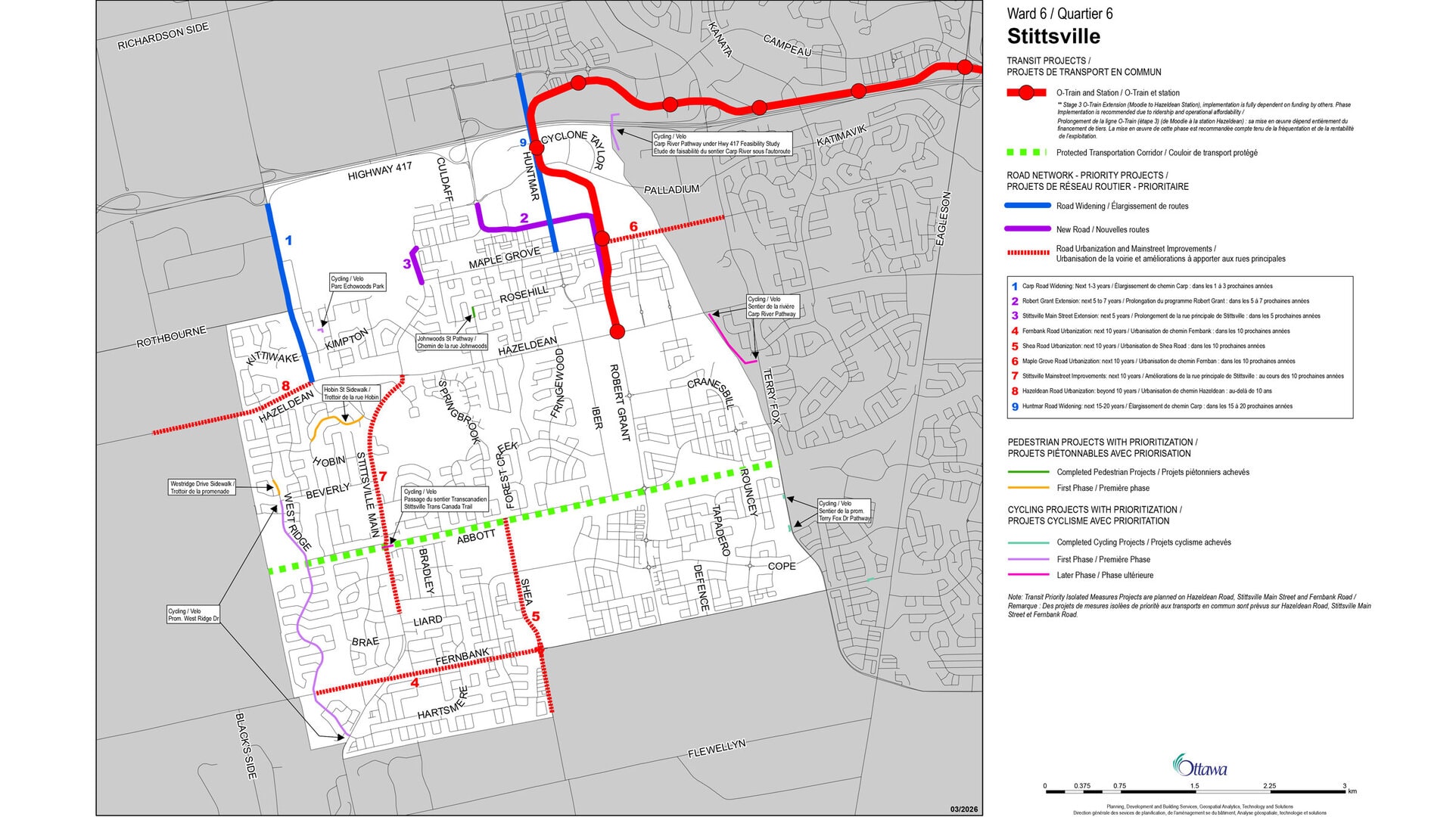
Map of planned transportation infrastructure in Stittsville
CARNET DE NOTES : Pourquoi la croissance se poursuit même lorsque les infrastructures routières ne sont pas encore prêtes
Le Conseil municipal peut-il suspendre l’aménagement de logements à Stittsville jusqu’à ce que le chemin Carp soit élargi ou jusqu’à ce que la construction du TLR soit terminée?
C’est une question que me posent beaucoup de résidents, et cela semble être une idée simple et logique. Cependant, en vertu des lois provinciales, la réponse est tout simplement « non ».
Nous pouvons arrêter un projet d’aménagement résidentiel s’il y a un manque de capacité des conduites d’eau et des égouts, ou s’il n’y a pas de branchement électrique. Toutefois, tant qu’il y a un accès routier, la construction peut se poursuivre (nous ne pouvons pas non plus arrêter des projets d’aménagement en raison d’un manque d’écoles ou de médecins de famille).
C’est une source de grande frustration pour les résidents. Nos banlieues connaissent actuellement une forte croissance. Cependant, les nouveaux projets de transport en commun et les travaux de modernisation des routes prévus pour accompagner cette croissance pourraient ne pas voir le jour avant plusieurs années.
C’est également une source de grande frustation pour les conseillers municipaux. En effet, l’an dernier, le Conseil municipal a demandé au personnel de « déterminer s’il est faisable d’établir des conditions liées aux infrastructures de transport pour les demandes de lotissement ou les projets d’aménagement de forte densité dans les zones d’expansion suburbaines, et de présenter un rapport à ce sujet ». Autrement dit : peut-on suspendre des projets d’aménagement jusqu’à ce que les routes et les transports en commun soient prêts à les soutenir?
Le mois dernier, nous avons reçu une réponse des Services de planification des transports de la Ville. Ils reconnaissent que la forte croissance — en particulier dans les secteurs suburbains — exerce une pression croissante sur le système de transport. Le personnel reconnaît aussi la nécessité d’investir dans des projets d’infrastructure de transport liés à la croissance, notamment grâce aux recettes provenant des redevances d’aménagement. Toutefois, pour ce qui est de retarder les projets d’aménagement pour permettre aux infrastructures de transport de rattraper leur retard, la réponse est sans équivoque : la Ville ne dispose pas du pouvoir législatif nécessaire pour agir ainsi. (Consultez la note de service intégrale ici)
La Ville peut exiger (et exige effectivement) des promoteurs qu’ils mettent en place des « services locaux », c’est-à-dire des infrastructures de transport destinées à desservir un site particulier. Il s’agit notamment de routes et de trottoirs résidentiels situés dans le quartier, ainsi que de feux de signalisation, de carrefours giratoires et d’intersections où les routes locales rejoignent les routes collectrices et les artères principales.
Cependant, nous ne pouvons pas les obliger à financer une amélioration majeure du chemin Carp, par exemple. Cela relève de la responsabilité de la Ville d’Ottawa.
Nous ne pouvons pas non plus subordonner un projet d’aménagement à un service de transport en commun. Dans notre nouveau Plan officiel, nous avons essayé d’ajouter une politique pour exiger un service de transport en commun dans les nouveaux quartiers, mais la Province s’y est opposée.
Malheureusement, cette réponse technique n’est pas très satisfaisante. Le système actuel n’est pas juste envers les résidents qui attendent des années pour de nouvelles infrastructures tout en voyant les routes locales devenir plus encombrées et plus dangereuses.
Alors, que pouvons-nous faire?
Une solution consiste à collaborer avec les promoteurs pour donner suite aux préoccupations de la communauté concernant la circulation et les infrastructures. Par exemple, j’ai travaillé avec l’entreprise Lépine, qui a accepté de retarder la construction d’une partie du projet d’aménagement situé au 5000, avenue Robert Grant jusqu’à ce que l’avenue Robert Grant soit aménagée au moins jusqu’au chemin Maple Grove.
Il arrive que des promoteurs choisissent volontairement de réaliser d’importants projets routiers avant l’échéance prévue par la Ville, lorsqu’ils en ont besoin pour assurer l’accès au quartier. Le prolongement de l’avenue Robert Grant, entre la rue Abbott et le chemin Hazeldean en est un bel exemple : les promoteurs ont devancé les travaux pour améliorer l’accès au quartier Abbott’s Run de Minto et seront remboursés ultérieurement par la Ville.
Nous pouvons également demander des « ententes de service précoce » financées par les promoteurs afin d’offrir des services de transport en commun plus tôt dans un quartier. Ce type d’entente a été mis en œuvre aux premiers stades de l’aménagement du quartier Blackstone. Là encore, la démarche était volontaire de la part du promoteur. Parallèlement, le personnel municipal modifie les politiques de la Ville pour permettre l’installation plus rapide de carrefours giratoires ou de feux de circulation aux principales intersections. Au lieu d’attendre plusieurs années que le volume de circulation « justifie » l’installation de feux, l’objectif est de les mettre en place dès le début du projet d’aménagement, avant l’arrivée des résidents.
L’intersection de Fernbank et d’Edenwylde, à Stittsville, en est un excellent exemple. Selon l’ancienne politique, cette intersection ne répondait pas techniquement aux critères requis pour l’installation de feux de circulation; les résidents doivent donc composer avec un passage pour piétons dangereux depuis plusieurs années. Des feux seront finalement installés l’an prochain. Toutefois, en vertu de la nouvelle politique, ces feux auraient probablement été installés dès le début des travaux.
Il en va de même pour les panneaux « Arrêt » et les passages pour piétons. L’ancienne politique ne prévoyait leur installation que lorsqu’un certain niveau de circulation et de fréquentation dans le quartier était atteint. La nouvelle politique impose leur mise en place dès le départ. Cela améliorera la sécurité et devrait également s’avérer moins coûteux.
Le personnel de la Ville modifie aussi les modalités de financement. Le Conseil a récemment approuvé un projet pilote de budgétisation agile des immobilisations pour les projets d’expansion du réseau routier afin de lever les obstacles et de lancer davantage de projets. Le personnel entame également plus tôt les phases de conception et d’acquisition de terrains. Toutes ces mesures auraient probablement permis de démarrer plus rapidement les travaux de modernisation du chemin Carp.
Le casse-tête du financement
Le plus grand obstacle figuré à l’accélération de la construction des routes et des réseaux de transport en commun est le financement. La plupart des grands projets sont financés par les redevances d’aménagement, qui peuvent prendre beaucoup de temps à s’accumuler avant qu’un projet ne puisse commencer. Nous pourrions emprunter de l’argent pour renforcer notre budget consacré aux routes, mais les municipalités sont soumises à des limites strictes quant au montant qu’elles peuvent emprunter. De plus, le coût des intérêts est répercuté sur votre facture d’imposition foncière, ce qui représente un montant considérable lorsque la dette s’élève à plusieurs centaines de millions de dollars.
Je suis modérément optimiste et j’ai bon espoir que nous serons peut-être à la veille d’un nouvel accord de financement municipal/provincial/fédéral pour l’infrastructure. Le Programme de réduction des redevances d’aménagement prévoit le remplacement des redevances d’aménagement pour les nouvelles maisons par un transfert direct de fonds initiaux aux municipalités. Si ce programme et cette source de financement devaient devenir permanents, cela pourrait aider les villes à mener à bien davantage de leurs projets de transport dans des délais plus courts. L’avenir nous le dira.
À court terme, la croissance devrait donc continuer de devancer le développement des infrastructures. Toutefois, si la Ville et la Province parviennent à accélérer les projets routiers et de transport en commun grâce à des changements de politique et de meilleurs mécanismes de financement, l’écart commencera à se réduire — non pas en ralentissant les projets d’aménagement, mais en construisant les infrastructures plus rapidement.
Carte des infrastructures de transport prévues à Stittsville