La version française suit
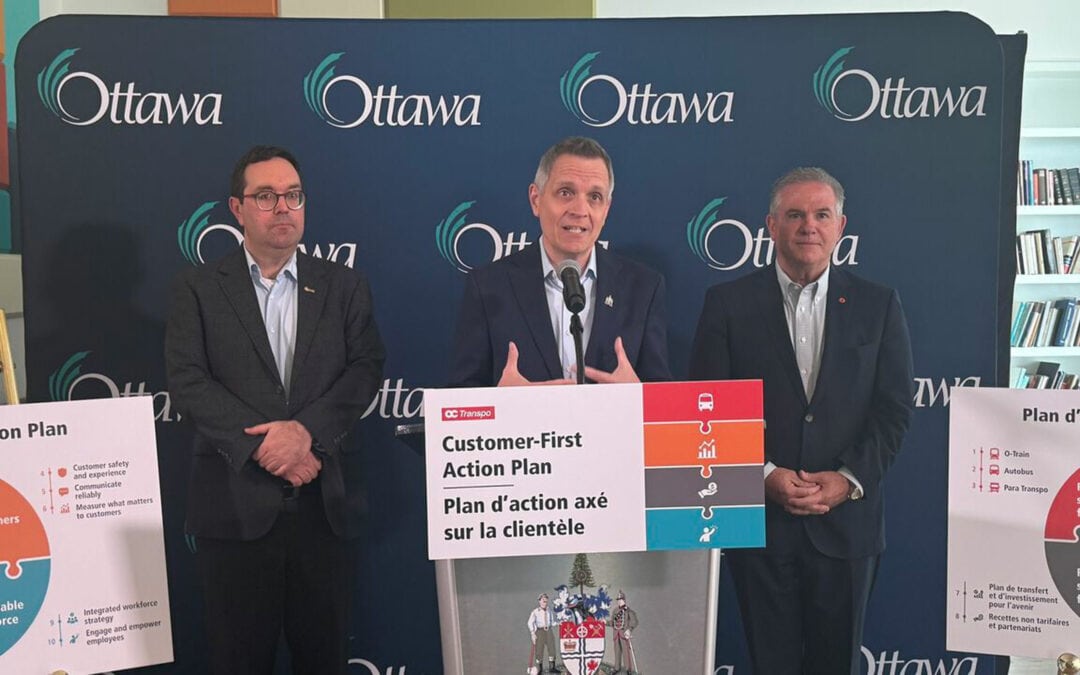
This morning I joined OC Transpo General Manager Rick Leary and Mayor Mark Sutcliffe at City Hall for a media conference. After joining OC Transpo in late March, Leary was ready to present his priorities for the transit agency.
Here is a copy of his speaking notes, plus a media hand-out distributed today. We’ll get additional information at Transit Committee on Thursday. (I’ve added bold at the start of each section for clarity.)
Check against delivery
Good morning, Bonjour.
Thank you, Mayor. It’s my honour to be here today in the role of General Manager of OC Transpo in our Nation’s Capital.
In my first 30-days here, I have spent time listening and speaking to customers, union leaders, employees, and members of Council.
I have received a lot of feedback, and I appreciate all of the discussions.
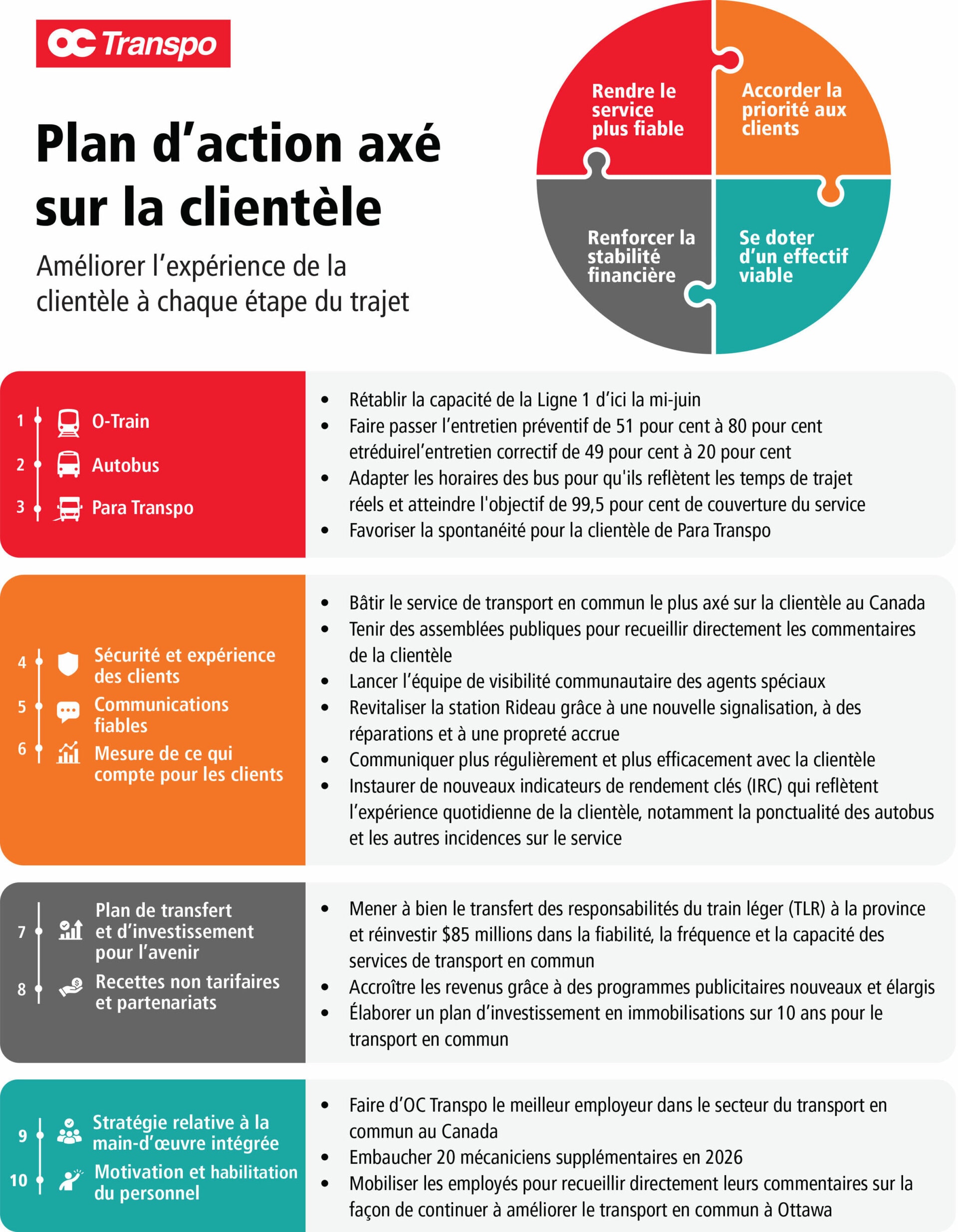
Today, I’d like to talk to you about my initial assessment and the 10 points that will drive change in our transit system.
Since joining the City of Ottawa, I have been using our bus and O-Train system, and I’ve visited our control centre and garages to see them in action.
I am excited by the potential to improve transit in Ottawa.
I have said it before and I mean it, the sorts of issues OC Transpo has experienced are not unique to Ottawa. Transit agencies across North America have all faced similar issues.
City Council has invested in the bus fleet, O-Train, new Para Transpo vehicles, infrastructure upgrades as well as customer improvements and technology that lay a solid foundation for good transit service.
We have all the components to turn the page and improve OC Transpo service reliability for our customers.
My job is to turn those initiatives into real improvements residents can see and feel in a strong, more reliable transit system that is worthy of our capital city.
Based on my initial 30-day assessment, I have created OC Transpo’s Customer-First Action Plan.
This plan is grounded in one core principle: improving the customer experience at every step of the transit journey.
We want to build the most customer-focused transit service in Canada.
This action plan has four key areas of focus to drive results:
- Make service reliable
- Put customers first
- Strengthen financial stability
- Build a sustainable workforce
These areas reflect the clear direction the City Manager has provided to me, further supported by the Mayor and Transit Committee Chair, who are here with me today, as well as the feedback I’ve received so far and my experience at other transit agencies.
Improvements in all of these areas translates into the transit system this City expects and deserves – reliable, predictable and sustainable.
At the Transit Committee on Thursday, I’ll go into more details about the action plan. For now, I’d like to provide an overview of how we will drive change through this plan.
First, we need to make service more reliable.
We must improve the reliability of our O-Train, bus and Para Transpo services.
As I mentioned, the direction made clear to me on my first day was to restore capacity to Line 1. We’re making progress here.
I’m pleased to be able to say that double-car trains will be back in operation by mid-June.
Line 1 will have the capacity to welcome everyone, whether they’re returning to the office more often or taking part in Canada Day celebrations or Bluesfest this summer.
I’d like to let you know that in my short time here, I have observed that the O-Train service is frequent and reliable.
We have a positive and collaborative relationship with our maintainers – Rideau Transit Group and Alstom. Today I can tell you that they will join us at Thursday’s Transit Committee to answer questions about getting back to the capacity residents expect.
The second clear direction to me was to build back bus reliability.
We know that our customers’ experience of buses arriving on-time at their stops is only about 65 to 70 per cent.
We know we can improve this. To get there, we need to have:
• buses that are reliable
• and a schedule that is attainable.
Maintaining 20-year-old buses is very, very difficult.
Our intent will be to re-focus the way we plan maintenance. Right now, our team splits their time almost equally on corrective repairs and preventative work.
This needs to change.
We should spend 80 per cent of our time on preventative maintenance and only 20 per cent on corrective work.
We have a clear path when it comes to our fleet:
- Over the course of the next year, focus on putting into service new zero emission buses and the new 60-foot buses the City has purchased,
- Prioritize our maintenance hours on vehicles that will be dependable for customers, and
- Retire the least reliable buses that require the most frequent and intensive repairs.
The good news is that I have seen service start to improve.
I am confident that we will continue to see significant improvements in the coming months.
As I mentioned earlier, the second component is adjusting our schedules to reflect real travel times. We want our customers to have schedules they can rely on.
This action also addresses what I have heard from our union leaders and frontline operators.
We have already added time to the schedules of a number of routes to account for real travel times. We’re going to continue to expedite this work until all necessary routes have been reviewed and updated.
Allocating accurate travel time will mean that schedules are predictable for customers.
Para Transpo customers are another important part of our transit service.
We have good discussions with Para Transpo customers, but we want to hear from you on how the service can continue to improve to support spontaneity, participation in the community and quality of life. As part of this plan, we’ll launch a new consultation process to hear how you would like to see Para Transpo continue to grow.
In the next area, our focus is enhancing how we put customers first.
I have said that this action plan will put customers first in every service-related decision that OC Transpo makes.
To do this, there are three action points:
- Customer safety and experience
- Communicate reliably, and
- Measure what matters to customers
These will shift operational decisions to deliver results for customers.
Part of service improvements is providing a clean, comfortable and safe experience on our vehicles and in our stations.
Our work here is already underway.
Our team is giving the entire bus, Para Transpo and O-Train system a deep clean for spring to increase customer comfort.
Our forthcoming Public Safety Strategy will outline a number of initiatives to improve comfort, safety and security on the system.
This strategy includes:
- The launch of the Special Constables’ community visibility team on bikes and foot patrols downtown
- In the coming weeks, you’ll see employees at Rideau Station as we put in new efforts to revitalize the station with repairs, signage and cleanliness
- And a more visible presence of our Special Constables and other employees across the network.
We’re also committed to ensuring our customers know the progress we’re making. Our commitment is to communicate regularly and effectively with customers to follow through on our priorities.
Finally, data will fuel our decisions. The data we use needs to reflect the daily experience of our customers, and our reporting needs to represent their real-life experience.
We’re developing new Key Performance Indicators that will help guide our discussions and decisions. By understanding what customers experience daily, we can better address their concerns.
I’m going to introduce KPIs at Transit Committee that will reflect the customer experience. For instance, we know that approximately 17 per cent of our fleet experiences issues while in service.
That means customers’ trips are impacted.
That needs to change, and we’ll report on how our efforts are making real improvements.
I’ll talk now about strengthening our financial stability.
Council has made significant investments in purchasing zero emission buses, improving the infrastructure around these buses, building a light rail system and customer improvements over the last number of years.
By uploading LRT to the Province, the City can eliminate $85 million in annual budget pressures creating capacity to reinvest in transit services, enhancing reliability, frequency and capacity while strengthening our financial position.
I look forward to working with the Mayor and our provincial colleagues to advance this very important work.
Another component to long-term financial viability and planning is building a 10-year capital investment plan for transit.
We’ll also make our federal partners aware of our long-term needs. We can deliver better transit when all levels of government are working together.
We are leaving no stone unturned to improve our bottom line.
The team is working to increase revenues from non-traditional sources, like digital advertising, and to bring OC Transpo’s program in line with other industry leaders. We are also pursuing innovative partnerships with major employers and other organizations to design fare packages that can result in additional revenue over the long term.
Finally …to do this, we need to build a sustainable workforce.
Our employees keep the entire transit system moving every day and they are our frontline ambassadors to customers. We want to ensure that they are supported, engaged and empowered so that we are the top transit employer in Canada.
Our integrated workforce strategy will accelerate recruitment of frontline positions that directly support service delivery.
These are mechanics, bus and Para Transpo operators and diesel and electric rail operators, as well as Controllers and Special Constables.
We have successfully hired nine mechanics since January, almost half of our target of 20 new mechanics this year to keep our buses running reliably.
In transit, we need to be two steps ahead of our hiring process and forecast our future needs.
I am also committed to building an engaged and informed workforce.
What you’ve heard today is the result of employee feedback, and I look forward to continuing these discussions.
I know it’s unusual to speak publicly ahead of Transit Committee, but I felt it was important to speak directly to customers.
Residents deserve to know that we have a clear plan to improve reliability, strengthen service, and rebuild confidence in OC Transpo.
I invite residents to tune into Thursday’s meeting at 9:30am to hear more about the work ahead. And I’ll be launching a series of town halls to hear directly from OC Transpo customers. I want their feedback and ideas on how we can improve service… I’m sure they have lots of things in mind.
Over the next 60 and 90 days, we will continue to peel the onion, to dig deeper to provide more details on the current state, the path forward and how we’ll achieve our goals and report back on our work.
I’m excited for OC Transpo’s future and realizing its full potential. As I said earlier, these issues are not unique to Ottawa.
OC Transpo has a solid foundation. There are good people who have the skills and passion to deliver quality service. From here we can build the transit service customers deserve and expect.
I am excited to bring my knowledge, experience, a fresh approach and direction to improving transit.
I would now like to invite Chair Gower to say a few words.
Thank you, Merci.
NOTES DE PRÉSENTATION : Le plan en dix points de Rick Leary pour OC Transpo
Ce matin, j’ai rejoint le directeur général d’OC Transpo, Rick Leary, et le maire Mark Sutcliffe à l’hôtel de ville pour une conférence de presse. Après son entrée en poste à la fin du mois de mars, Rick Leary est fin prêt à présenter ses priorités pour la société de transport.
Voici ses notes d’allocution et un document pour les médias, remis aujourd’hui. Nous aurons plus d’informations à la réunion du Comité du transport en commun ce jeudi. (Par souci de clarté, j’ai mis le début de chaque section en gras.)
Seul le discours prononcé fait foi.
Bonjour, good morning.
Merci, Monsieur le Maire. J’ai l’honneur d’être ici aujourd’hui, dans notre capitale nationale, en tant que directeur général d’OC Transpo.
Les 30 premiers jours de mon mandat, je les ai passés à l’écoute des clients, des dirigeants syndicaux, du personnel et des membres du Conseil municipal.
J’ai reçu de nombreux commentaires, et j’ai apprécié toutes les conversations.
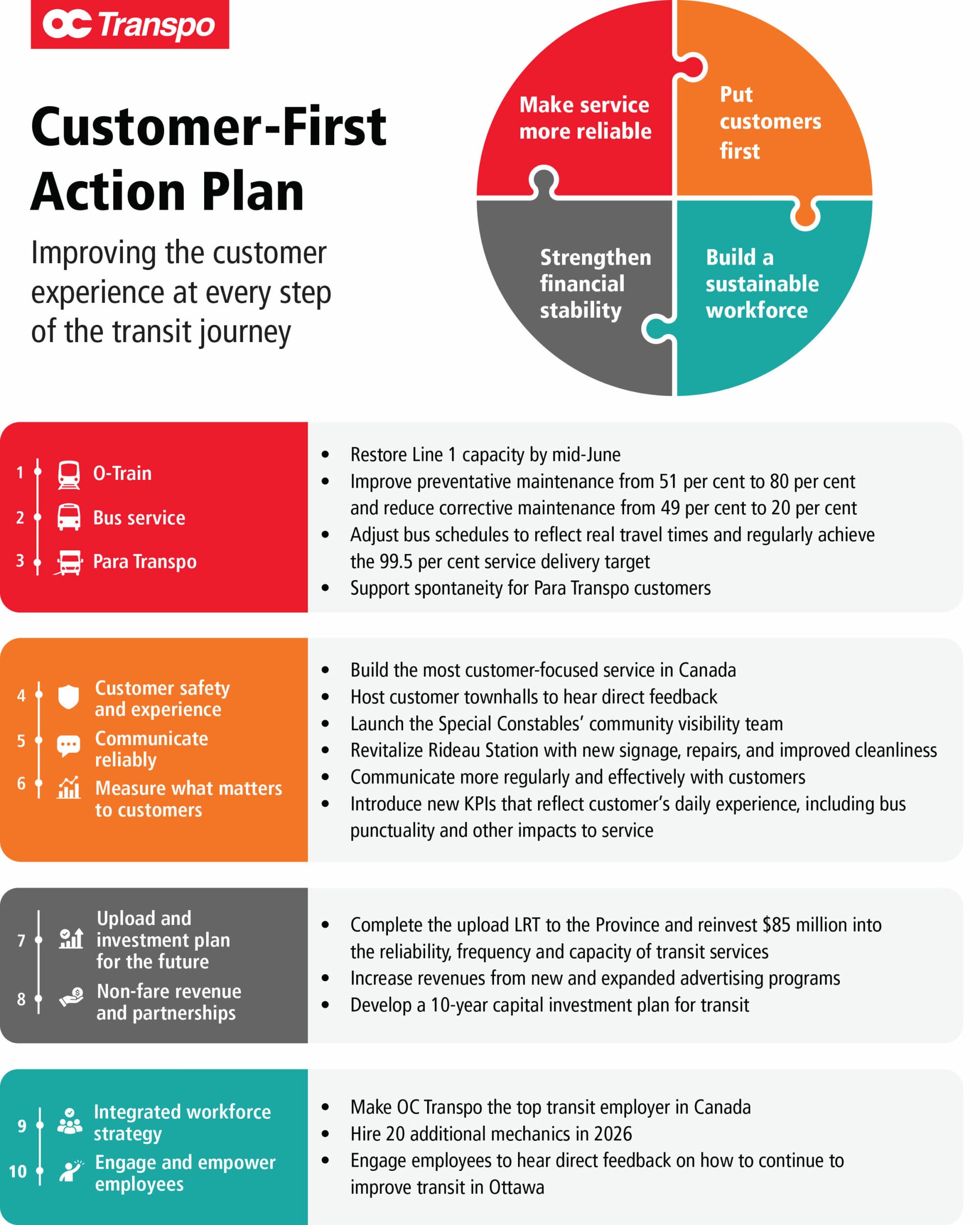
Aujourd’hui, j’aimerais vous présenter mon évaluation initiale et les dix points qui transformeront notre réseau de transport en commun.
Depuis mon arrivée à la Ville d’Ottawa, j’ai utilisé les réseaux de bus et de l’O-Train. J’ai également visité le Centre de contrôle et les garages pour les voir à l’œuvre.
L’idée d’améliorer les transports en commun à Ottawa m’enthousiasme.
Je l’ai déjà dit et je le pense : les problèmes rencontrés par OC Transpo ne sont pas propres à Ottawa. Partout en Amérique du Nord, les enjeux sont les mêmes.
Le Conseil municipal d’Ottawa a investi dans ce qui contribue à une base solide pour les transports en commun : le parc d’autobus, l’O-Train, les nouveaux véhicules de Para Transpo, la modernisation des infrastructures ainsi que des améliorations pour la clientèle et des outils technologiques.
Nous disposons de tous les éléments nécessaires pour tourner la page et améliorer la fiabilité des services d’OC Transpo pour nos clients.
Mon travail consiste à prendre ces initiatives et à en faire des améliorations concrètes, pour que les Ottaviennes et Ottaviens puissent disposer d’un système solide, fiable et digne de notre capitale.
Après une évaluation initiale de 30 jours, j’ai élaboré un plan d’action axé sur la clientèle pour OC Transpo.
Il repose sur un principe fondamental : améliorer l’expérience de la clientèle à chaque étape de son trajet.
Nous voulons bâtir le service de transport en commun le plus axé sur la clientèle au Canada.
Ce plan d’action s’articule autour de quatre grands axes :
- Rendre le service fiable
- Accorder la priorité aux clients
- Renforcer la stabilité financière
- Se doter d’un effectif viable
Ces quatre axes reflètent l’orientation claire donnée par la directrice municipale et appuyée par le maire ainsi que le président du Comité du transport en commun, qui sont d’ailleurs ici aujourd’hui, sans oublier les commentaires que j’ai reçus et mon expérience dans d’autres sociétés de transport en commun.
Ces quatre axes serviront à bâtir le système de transport que cette ville espère et mérite : fiable, prévisible et viable.
Je donnerai plus de détails sur le plan d’action pendant la réunion du Comité ce jeudi. Pour l’instant, voyons ensemble la manière dont nous transformerons le transport en commun grâce à ce plan.
D’abord, nous rendrons le service plus fiable.
Nous devons améliorer la fiabilité de l’O-Train, des bus et de Para Transpo.
Comme je l’ai mentionné, dès mon premier jour, on m’a donné pour directive de rétablir la capacité de la Ligne 1. Nous faisons des progrès de ce côté-là.
Je suis heureux de pouvoir annoncer que les trains à deux voitures seront de nouveau en service à la mi-juin.
La Ligne 1 pourra accueillir tout le monde : les gens qui retourneront plus souvent au bureau ou ceux qui iront au Bluesfest ou aux festivités de la fête du Canada cet été.
Depuis le peu de temps que je suis ici, je peux témoigner de la fiabilité et de la fréquence du service de l’O-Train.
Nous avons une collaboration et une relation fructueuses avec nos équipes d’entretien : Alstom et le Groupe de transport Rideau. Aujourd’hui, je peux vous confirmer qu’ils seront des nôtres à la réunion de jeudi pour répondre aux questions concernant le retour à la capacité attendue par les résidentes et résidents.
Une autre directive claire était de rétablir la fiabilité des bus.
Pour notre clientèle, les bus n’arrivent à l’arrêt à l’heure prévue que dans 65 à 70 % des cas.
Nous savons que nous pouvons faire mieux. Pour y parvenir, il nous faut :
- des bus qui sont fiables;
- et un horaire réaliste.
Il est très, très difficile d’entretenir des bus vieux de 20 ans.
Notre intention, ce sera de changer la façon dont nous planifions l’entretien. À l’heure actuelle, nos équipes passent autant de temps à faire des réparations que de la prévention.
Cette situation doit changer.
Nous devrions faire de l’entretien préventif 80 % du temps et des réparations les 20 % restants.
Nous avons une trajectoire claire en ce qui concerne notre parc de véhicules :
- au cours de l’année à venir, nous concentrer à mettre en service de nouveaux autobus à émission zéro et les nouveaux autobus de 60 pieds achetés par la Ville;
- entretenir en priorité les véhicules fiables pour notre clientèle;
- retirer les bus les moins fiables qui nécessitent des réparations fréquentes et intensives.
La bonne nouvelle, c’est que j’ai constaté que le service commençait à s’améliorer.
Je suis convaincu que nous continuerons à voir des améliorations importantes dans les mois qui viennent.
Comme je l’ai mentionné, la deuxième composante est d’ajuster nos horaires selon le temps de trajet réel. Nous voulons donner à notre clientèle des horaires auxquels elle peut se fier.
Nous répondons ainsi également aux enjeux soulevés par les dirigeants syndicaux et le personnel de première ligne.
Nous avons déjà élargi des horaires pour tenir compte des temps de trajet réels, et nous continuerons à le faire rapidement jusqu’à ce que les horaires de toutes les lignes aient été ajustés et mis à jour.
Avoir un itinéraire précis, c’est avoir des horaires prévisibles pour notre clientèle.
Les services pour la clientèle de Para Transpo sont une autre partie importante de notre travail.
Nous avons de bonnes discussions avec la clientèle de Para Transpo, mais nous voulons savoir comment bonifier encore le service pour favoriser la spontanéité, encourager la participation de la communauté et améliorer la qualité de vie. Dans le cadre de ce plan, nous lancerons un nouveau processus de consultation pour savoir comment vous aimeriez voir Para Transpo évoluer.
Le prochain grand axe, c’est de placer notre clientèle au centre de ce que nous faisons.
J’ai dit que, dans ce plan d’action, nous mettrions la clientèle au cœur de toutes les décisions prises par OC Transpo en matière de services.
Nous comptons y parvenir de trois manières :
- améliorer la sécurité et l’expérience de la clientèle;
- communiquer efficacement;
- sonder la clientèle pour savoir ce qui compte pour elle.
Les décisions opérationnelles seront donc prises pour répondre aux besoins de la clientèle.
L’amélioration du service rime notamment avec propreté, confort et sécurité, dans nos véhicules comme dans nos stations.
Nous y travaillons déjà.
Pour le confort de la clientèle, notre équipe s’attelle à nettoyer en profondeur tout le parc d’autobus et de trains pour le printemps.
Notre prochaine stratégie de sécurité publique portera sur un certain nombre d’initiatives visant à améliorer le confort, la sécurité et la sûreté dans le réseau.
Cette stratégie comprend ce qui suit :
- Nous lancerons l’Équipe de visibilité communautaire avec des constables spéciaux qui feront des patrouilles à vélo et à pied dans le centre-ville.
- Dans les semaines à venir, vous verrez le personnel à l’œuvre à la station Rideau, car nous nous efforçons de la revitaliser par des réparations, de la signalisation et du nettoyage.
- Vous verrez également plus de constables spéciaux et d’autres membres du personnel partout dans le réseau.
Nous tenons également à tenir notre clientèle au courant des progrès que nous faisons. Nous voulons communiquer régulièrement et efficacement, pour qu’elle voie que nous respectons nos priorités.
Enfin, les données orienteront nos décisions. Les données que nous utilisons doivent refléter l’expérience quotidienne de notre clientèle, et nos rapports doivent représenter leur expérience véritable.
Nous élaborons de nouveaux indicateurs de rendement clés (IRC) qui nous aideront à orienter nos discussions et nos décisions. En comprenant ce que notre clientèle vit au quotidien, nous pouvons mieux répondre à ses préoccupations.
Je vais présenter au comité des IRC qui reflètent l’expérience de la clientèle. Par exemple, nous savons qu’environ 17 % de notre parc rencontre des problèmes en cours de service.
Autrement dit, les trajets de notre clientèle sont touchés.
Il faut que cette situation change. Nous rendrons compte de la manière dont nos efforts se transposent en améliorations réelles.
Je vais maintenant parler du renforcement de notre stabilité financière.
Au cours des dernières années, le Conseil a réalisé des investissements importants pour l’achat d’autobus à émission zéro, l’amélioration de l’infrastructure les concernant, la construction d’un système léger sur rail (SLR) et l’amélioration du service à la clientèle.
En transférant la responsabilité du SLR à la Province, la Ville s’éviterait 85 millions de dollars de pressions budgétaires annuelles qu’elle pourrait réinvestir dans les services de transport en commun pour en améliorer la fiabilité, la fréquence et la capacité, tout en renforçant sa situation financière.
Je me réjouis de travailler avec le maire et nos collègues provinciaux pour faire avancer ce travail essentiel.
Un autre élément de la viabilité et de la planification financière à long terme est l’élaboration d’un plan d’investissement décennal pour les transports en commun.
Nous ferons également connaître à nos partenaires fédéraux nos besoins à long terme. C’est lorsque tous les ordres de gouvernement collaborent que nous pouvons transformer les transports en commun.
Nous ne négligeons rien pour atteindre nos objectifs.
L’équipe s’efforce d’augmenter les recettes provenant de sources non traditionnelles, comme la publicité en ligne, et de mettre OC Transpo au même niveau que les leaders du secteur. Nous recherchons également des partenariats innovants avec les principaux employeurs et d’autres organisations, afin de concevoir des offres tarifaires susceptibles de générer des revenus supplémentaires à long terme.
Enfin… pour faire tout cela, il nous faut nous doter d’un effectif viable.
Les membres de notre personnel sont le pilier qui soutient tout notre système de transport. Ce sont leurs visages que notre clientèle voit. Nous voulons qu’ils se sentent soutenus, impliqués et encouragés. Nous voulons être le meilleur employeur en transports en commun au Canada.
Notre stratégie intégrée en matière de main-d’œuvre accélérera le recrutement pour les postes de première ligne directement liés à la prestation de services.
Il s’agit des mécaniciens, des chauffeurs d’autobus et de Para Transpo, des opérateurs de trains diesel et électriques ainsi que des contrôleurs et des constables spéciaux.
Nous avons réussi à embaucher 9 mécaniciennes et mécaniciens depuis janvier, ce qui représente presque la moitié de l’objectif (20 embauches) pour assurer la fiabilité des bus.
Dans le domaine des transports en commun, nous devons anticiper notre processus de recrutement et prévoir nos besoins futurs.
Je souhaite également que nous ayons une main-d’œuvre impliquée et informée.
Ce que vous avez entendu aujourd’hui, c’est le résultat des discussions avec le personnel. J’ai à cœur de poursuivre ces conversations.
Je sais qu’il est inhabituel de s’exprimer en public avant la réunion du Comité, mais je trouvais important de m’adresser directement à notre clientèle.
Les Ottaviennes et Ottaviens méritent de savoir que nous avons un plan clair pour améliorer la fiabilité, renforcer le service et rétablir la confiance dans OC Transpo.
J’invite les gens à visionner la réunion de jeudi à 9 h 30 pour découvrir ce qui s’en vient. Je vais également tenir des réunions publiques pour sonder directement notre clientèle. Je veux entendre ses commentaires et ses idées sur l’amélioration du service. Je suis sûre qu’elle a beaucoup à nous dire.
Dans les 60 à 90 jours qui suivent, nous continuerons à creuser, de plus en plus profondément, pour vous parler de l’état des lieux et de la voie à suivre. Nous saurons comment atteindre nos objectifs et rendrons compte de leur avancement.
L’avenir d’OC Transpo s’annonce prometteur, et je constate tout son potentiel. Comme je le disais, ces problèmes ne sont pas propres à Ottawa.
OC Transpo a de bonnes bases. Nous avons une bonne équipe qui a les compétences et la passion nécessaires pour offrir un service de qualité. C’est grâce à cela que nous pourrons mettre en place le service de transport en commun que notre clientèle mérite et espère.
Je suis enchanté d’offrir mes connaissances et mon expérience pour bâtir une nouvelle approche et une nouvelle orientation dans l’amélioration des transports en commun.
J’invite maintenant le président, Glen Gower, à prononcer quelques mots.
Merci, thank you.