
La version française suit
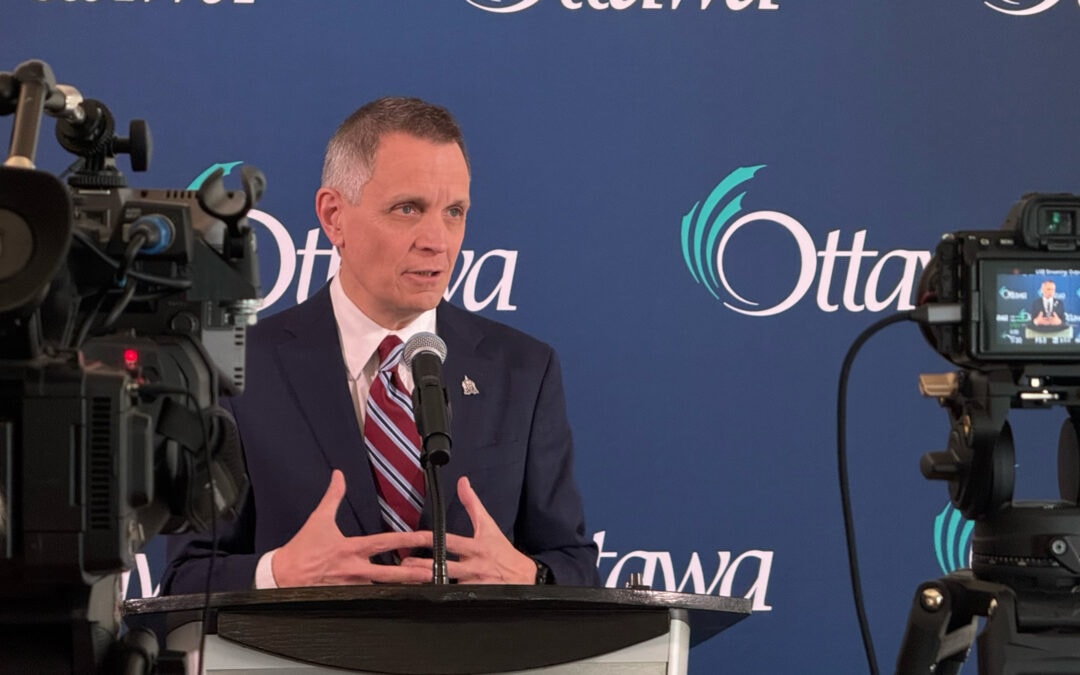
Last Tuesday, Mayor Mark Sutcliffe and Ontario Transportation Minister Prabmeet Sarkaria signed a Memorandum of Understanding that will commit both parties to upload ownership and responsibility for the O-Train and Highway 174 in the east end from the City of Ottawa to the Province.
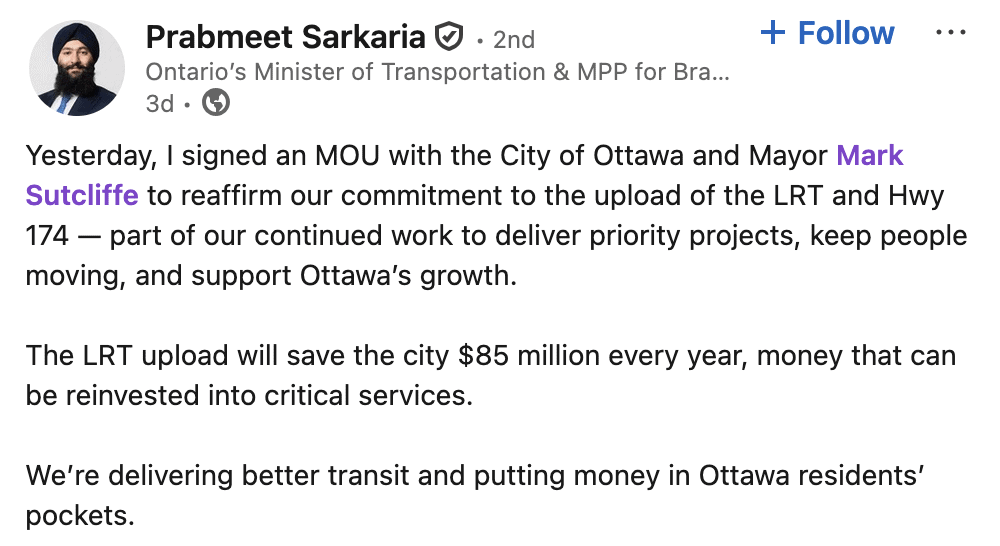
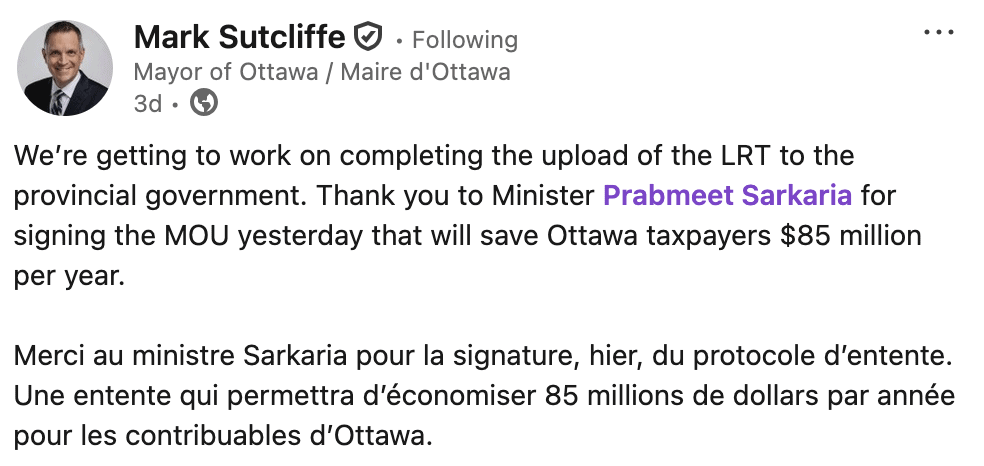
Both moves would mean savings in the tens of millions of dollars for Ottawa residents, but I want to focus on the O-Train piece, and what it could mean for OC Transpo in the future.
- A $4-billion financial benefit. The upload will remove a $4 billion cost on Ottawa taxpayers, representing the capital, maintenance, and operating costs of the O-Train system over its lifespan. And it would shift the financial risk of the LRT system to the province. That’s approximately $85 million every year that can be reinvested in better transit: expanded bus service, more routes, more frequency, more reliability.
- A partnership with Metrolinx. The provincial upload would put Ottawa’s LRT under the ownership and control of Metrolinx, the provincial agency that runs most of the commuter rail systems in southern Ontario. Metrolinx would bring scale, and leverage, and experience so that problems get solved faster.
- LRT to Stittsville. As part of the upload, the City of Ottawa will be looking for a commitment from the Province to move forward with Stage 3 Light Rail which would bring LRT to Kanata, Stittsville, and Barrhaven. The Premier made this commitment during the 2025 provincial election.
- Fairness for Ottawa. Going back to at least August 2024, Mayor Sutcliffe has flagged a huge discrepancy in how the Province funds transit in southern Ontario as compared to Ottawa. For example, Ottawa taxpayers are paying about 55% of the cost of building Stage 1 and 2 of light rail, with the province and federal government splitting the remaining 45%. Meanwhile in Toronto, Mississauga, Hamilton, and Brampton, local taxpayers pay only about 5%. The LRT upload would fix that imbalance, and return the money that we invested.
There are some legitimate concerns about risk to the City by partnering with Metrolinx. Last fall, City Council approved a motion from me and the Mayor listing the key principles and goals that we have for any upload deal, including:
- that a deal must be fair to Ottawa taxpayers and consistent with precedent deals reached in other Ontario municipalities
- that the governance structure of Metrolinx includes appropriate mechanisms to ensure accountability and transparency for Ottawa residents
- that Metrolinx has a significant presence and adequate resources in Ottawa to meet its commitments to the City of Ottawa and OC Transpo
- that OC Transpo maintain local control over service delivery and hiring of personnel
There’s no firm timeline for when construction for Stage 3 light rail may begin, but the MOU is an important step in the process. We’re likely looking at 12-18 months before a final deal is reached – I think 2027 would be a relatively safe bet for a decision.
In the west end, the LRT route would run parallel to the Queensway, cross the highway at Canadian Tire Centre, and continue on elevated tracks to the last station, located at Hazeldean Road and Robert Grant Avenue across from the Chipotle. Rail Fans Canada produced a great video demonstrating the route and stations for LRT Stage 3 through Kanata and Stittsville. Worth watching: https://www.youtube.com/watch?v=jiOJCViey1k
CARNET – Pourquoi le transfert provincial du train léger sur rail est important pour le transport en commun et les contribuables d’Ottawa
Mardi dernier, le maire Mark Sutcliffe et le ministre des Transports de l’Ontario, Prabmeet Sarkaria, ont signé un protocole d’entente qui engage les deux parties à transférer de la Ville d’Ottawa à la Province la propriété et la responsabilité de l’O‑Train et de la route 174 dans l’est de la ville.
Ces deux mesures permettraient aux résidentes et aux résidents d’Ottawa d’économiser des dizaines de millions de dollars. Toutefois, je souhaite me concentrer sur le volet de l’O-Train et sur ce que cela pourrait signifier pour l’avenir d’OC Transpo.
- Un avantage financier de 4 milliards de dollars. Le transfert provincial éliminera un coût de 4 milliards de dollars pour les contribuables d’Ottawa, représentant les coûts d’immobilisations, d’entretien et d’exploitation du réseau de l’O-Train sur toute sa durée de vie. De plus, le risque financier du réseau de train léger sur rail (TLR) serait transféré à la province. Cela représente environ 85 millions de dollars chaque année qui pourraient être réinvestis dans un meilleur transport en commun : un service d’autobus élargi, plus de circuits, une fréquence accrue et une plus grande fiabilité.
- Un partenariat avec Metrolinx. Le transfert provincial placerait le TLR d’Ottawa sous la propriété et le contrôle de Metrolinx, l’organisme provincial qui exploite la plupart des réseaux de trains de banlieue dans le sud de l’Ontario. Metrolinx apporterait l’envergure, le pouvoir de négociation et l’expérience nécessaires pour résoudre les problèmes plus rapidement.
- Le TLR jusqu’à Stittsville. Dans le cadre du transfert, la Ville d’Ottawa cherchera à obtenir un engagement de la province pour aller de l’avant avec l’Étape 3 du projet de train léger, qui amènerait le TLR à Kanata, à Stittsville et à Barrhaven. Le premier ministre a pris cet engagement lors de l’élection provinciale de 2025.
- L’équité pour Ottawa. Depuis au moins août 2024, le maire Sutcliffe a signalé un écart énorme dans la façon dont la province finance le transport en commun dans le sud de l’Ontario par rapport à Ottawa. Par exemple, les contribuables d’Ottawa paient environ 55 % du coût de construction des étapes 1 et 2 du projet de train léger, la province et le gouvernement fédéral se partageant les 45 % restants. Pendant ce temps, à Toronto, à Mississauga, à Hamilton et à Brampton, les contribuables locaux ne paient qu’environ 5 %. Le transfert du TLR corrigerait ce déséquilibre et nous restituerait l’argent que nous avons investi.
Il existe des préoccupations légitimes concernant les risques pour la Ville d’un partenariat avec Metrolinx. L’automne dernier, le Conseil municipal a approuvé une motion du maire et de moi-même énumérant les principes et les objectifs clés que nous avons pour toute entente de transfert, notamment :
- que l’entente soit équitable pour les contribuables d’Ottawa et conforme aux ententes précédemment conclues dans d’autres municipalités de l’Ontario;
- que la structure de gouvernance de Metrolinx comprenne des mécanismes appropriés pour garantir la responsabilisation et la transparence envers les résidents d’Ottawa;
- que Metrolinx ait une forte présence et des ressources adéquates à Ottawa pour respecter ses engagements envers la Ville et OC Transpo;
- qu’OC Transpo conserve le contrôle local sur la prestation des services et l’embauche du personnel.
Il n’y a pas d’échéancier précis pour le début des travaux de construction de l’Étape 3 du projet de train léger, mais le protocole d’entente constitue une étape importante du processus. Nous envisageons vraisemblablement un délai de 12 à 18 mois avant qu’une entente finale soit conclue. Je pense que 2027 serait une estimation relativement prudente pour une décision.
Dans l’ouest de la ville, le tracé du TLR longerait la Queensway, traverserait l’autoroute à la hauteur du Centre Canadian Tire, et se poursuivrait sur des voies surélevées jusqu’à la dernière station, située à l’intersection du chemin Hazeldean et de l’avenue Robert-Grant, en face du Chipotle. Rail Fans Canada a produit une excellente vidéo présentant le tracé et les stations de l’Étape 3 du TLR à travers Kanata et Stittsville. À voir : https://www.youtube.com/watch?v=jiOJCViey1k